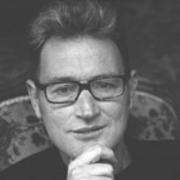
Peter Wells
At a time when local stories largely stayed on the straight and narrow, Peter Wells set out to bring a gay sensibility to the screen. His work was years ahead of its time, bringing sympathetic transgender characters, naked males and the tragedy of AIDS to mainstream audiences. Wells believed that New Zealand's distance from the rest of the world fuelled a distinctive local cinema which could be "potent, rich and expressive. Mix isolation and the power of dream, and you end up with something extraordinary."
Wells fell in love with film early. He recalls "laughing, screaming, yelling" to a Mickey Mouse cartoon at four.
He began acting as a nine-year-old, while growing up in the Auckland suburb of Point Chevalier. It was onstage that he first began to appreciate the interaction of a fantasy world with everyday life. At university, film studies had yet to arrive, but Wells continued to devour all the films he could. After completing a history degree he spent five years overseas. In London, a viewing of Rainer Werner Fassbinder's The Bitter Tears of Petra Van Kant made him realise it was possible to become a filmmaker. He also began writing short fiction, all of it "drenched" in New Zealand.
By 1979 Wells was back in Auckland. Working as a proofreader at The NZ Herald, he finished his night shift in time to catch the crew who were shooting short film Queen Street. In book Film in Aotearoa New Zealand, he describes this moment as "fantastically empowering". The mystery of film "collapsed as if someone had pulled a curtain away".
Annoyed by the "straight linear" approach of pioneering Kiwi gay movie Squeeze (1980), Wells set about making something both provocative, and less reliant on dialogue. The result, experimental short film Foolish Things (1980), won awards in Europe. It was the first of a series of gay-themed projects made with his then partner, (future) director Stewart Main.
Wells was developing a "feeling of solidarity" with many of the filmmakers emerging in this period, including Gregor Nicholas and Shereen Maloney. Each would make contributions to groundbreaking anthology series About Face (1985), which came about partly due to Wells' campaigning. With other independent filmmakers, he'd formed the New Film Group, feeling that short films were as valid — perhaps more so — than feature films. The NFG pressured the powers that be to devote more funding to shorts.
Wells main contribution to About Face was Jewel's Darl, a man's account of his relationship with a transgender person. Nominated for four NZ Television Awards including best One-Off Drama, it launched a number of careers — including that of future politician Georgina Beyer, who starred as Jewel. Years later Wells would co-direct Georgie Girl — an award-winning documentary about Beyer — with Annie Goldson. Wells also wrote coming of age episode My First Suit, for director Stewart Main. Both episodes were intended to break a drought on local gay characters. But it almost wasn't to be: as Wells detailed in this video interview, Jewel's Darl's screening was delayed for many months because a TVNZ executive felt it unacceptable to portray a transgender character who wasn't a figure of fun.
The following year, Wells and Main caught the zeitgeist with their teleplay A Death In The Family, based on the loss of a friend to AIDS. In the year that the homosexual law reform bill was working its way into law amid hysteria about AIDS, it was a hot button topic. The film was hailed locally, and screened around the world.
Elsewhere, Wells demonstrated his fascination with architecture. The Newest City On The Globe (1986) visited Napier, where he had family connections. The Mighty Civic (1988) was a love letter to the beloved Queen Street theatre of his childhood. Each mixes straight history with colourful flights of cinematic fancy. The Mighty Civic helped win support to save the theatre from demolition. Wells wrote about the Civic in this piece for NZ On Screen's sister site AudioCulture.
Writer David Herkt has argued that Wells was "consigned to unemployability for a time" after a scandal at this 1987 screen awards ceremony. Wells heckled guest presenter John Inman, who was known for a camp role on British sitcom Are You Being Served? Wells shouted out that he was a "sexist shit". In 1990 he mixed footage of the All Blacks with sexual imagery for short film A Taste of Kiwi.
Wells' only feature film was 1993's Desperate Remedies, which he wrote and directed with Stewart Main. Although made entirely indoors, this deliberately melodramatic take on New Zealand's colonial beginnings offered a flamboyant, expressionistic alternative to the man alone machismo that had dominated Kiwi storytelling. Jennifer Ward-Lealand and Cliff Curtis featured.
Selected for the Cannes Film Festival, Desperate Remedies quickly sold to over 25 countries. Screen International called it "an exuberant Victorian bodice ripper". Variety's David Stratton found it "a feast for the eyes and eyes", following a Cannes screening where many hooted "cheerfully at the pic's wild extravagancies and gay abandon". Reviewers for The Dominion and North and South argued that it staked out new ground from Kiwi realist traditions.
After Desperate Remedies, Wells was keen to "get back to the quiet of the page". His short stories, novels and non-fiction works won wide praise. But he did not entirely abandon other forms of drama. He helped write the script for 1998 Garth Maxwell feature When Love Comes, and collaborated with Colin McColl on Ricordi!, an operatic dramatisation of Katherine Mansfield's stories, for the 1996 NZ International Festival of the Arts.
There were many autobiographical works. His TV documentary Pansy (2001) charts his path to becoming a writer and filmmaker. It was accompanied by book Long Loop Home, in which Wells addresses coming out after being drafted to fight in Vietnam, and his relationship with his brother Russell, who died of AIDS in 1989. Wells wrote evocatively about his love affair with cinema in essay On Going to the Movies (which was published as a book in 2005), and about directing in a chapter of Film in Aotearoa New Zealand. His screen projects were analysed by American David Gerstner in a chapter of New Zealand Filmmakers.
Two short stories from Wells' collection Dangerous Desires have been filmed: Of Memory & Desire, the tale of a Japanese couple travelling in New Zealand, was adapted by director Niki Caro for her award-winning first feature Memory and Desire in 1997. Soon after Wells adapted his "small masterpiece" One of THEM! into a script. Set in the 60s, the gay coming of age tale was directed by Stewart Main as this hour-long TV film.
Dangerous Desires won three Kiwi book awards in 1992, and sold to an American publisher for what was said to be "a significant five-figure sum". Iridescence (2003) was a runner-up in the Montana NZ Book Awards, and a finalist for the 2005 Tasmania Pacific Fiction Prize. Another award allowed him to complete 2011 biography The Hungry Heart: Journeys with William Colenso. In 2006 Wells was made a Member of the NZ Order of Merit, for services to literature and film. He was a founder of the Auckland Writers and Readers Festival with novelist Stephanie Johnson, and (in 2016) New Zealand's first LGBTQI+ festival, SameSame But Different.
In early 2014 Wells wrote this introduction for NZ On Screen's Rainbow Collection. He invited readers to imagine themselves in a very different time: one where "your sexuality is illegal, eroticism forbidden and you must fight — fight to exist". That fighting spirit embraced even his own mortality. Wells' last book was published weeks before his death on 18 February 2019. Hello Darkness used Facebook posts and photographs to examine living with a terminal illness — prostate cancer.
Profile updated on 23 November 2022
Sources include
Peter Wells
'Peter Wells: Desperate Remedies and making queer films...' (Video Interview), NZ On Screen website. Director Andrew Whiteside. Loaded 12 May 2014. Accessed 31 March 2019
Pansy (Television Documentary) Director Peter Wells (MF Films, 2001)
Peter Wells, ‘Glamour on the Slopes: Or the Films We Wanted to Live’ in Film in Aotearoa New Zealand. Editors Jonathan Dennis and Jan Bieringa (Wellington: Victoria University Press, Second Edition 1996)
Peter Wells, On Going to the Movies (Wellington: Four Winds Press, 2005)
Peter Wells, 'Beneath the Skin' NZ On Screen website. Loaded 28 January 2014. Accessed 22 March 2019
Russell Baillie, 'Culture hero: Peter Wells, 1950 - 2019' - The Listener, 2 March 2019
David Herkt, 'Obituary: Author Peter Wells' Stuff website. Loaded 18 February 2019. Accessed 21 November 2022
Roger Robinson, 'Wells, Peter', Read NZ - Te Pou Muramura website. Accessed 21 November 2022
David Stratton, 'Desperate Remedies' (Review) - Variety, 7 June 1993
'Miramax buy North American rights to movie' - NZfilm no 50, October 1993, page 4