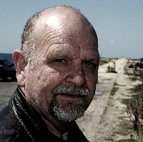
After more than 25 years in the film industry, Graeme Tetley has become one of New Zealand's most respected scriptwriters. His work has ranged from ghost stories (Mr Wrong) to impressionist coming of age tales (Vigil); through real-life tragedies (Out of the Blue) to domestic comedies (Ruby and Rata).
Tetley believes that New Zealand's most culturally specific films are "still our most successful". His scripts often explore the complexity and courage of ‘ordinary' - often female - New Zealanders.
Graeme Tetley was raised in Havelock North in the Hawke's Bay, where his formative influences included vaudeville, Saturday morning movie sessions and rock'n'roll.
While studying english and history at Canterbury University, Tetley grew increasingly interested in theatre. As an English-teacher, he wrote for a number of school productions, and acted in plays by Court Theatre co-founder Mervyn Thompson.
Tetley became curious about the mysterious world of filmmaking after witnessing it firsthand; after Murray Reece chose him to play the role of Mr Sullivan, father to the main character, in the tele-movie adaptation of the Ian Cross novel The God Boy (1976).
His first experience of scriptwriting began with a lucky break, then moved from confusion into excitement. A teaching colleague knew someone who was working on a feature film project. The director had more than a hundred cards, each with a drawing on it. He needed some dialogue. Though not too much. So began the long process of creative exploration which led to the internationally-acclaimed Vigil (1984), co-written by Tetley and director Vincent Ward. Tetley still uses cards to help structure his scripts today.
Tetley "ran away from teaching" to the farm where Vigil was being shot - writers traditionally enter film sets at their own risk - and was even invited to join Ward in the editing suite. In the process, Tetley watched and learned as Ward pursued his belief that "the image is central to film, because a film is a poem before it is story, character or even an idea." Although he loved teaching, it was time for a job change.
Next Tetley worked with director Gaylene Preston on the screenplay for Preston's debut feature Mr Wrong. It was the start of a writer/director collaboration that continues today. Based on a story by another actor-turned-writer (Brit novelist Elizabeth Jane Howard), this tale of woman, ghost and a second hand car was partly an attempt to avoid genre conventions of glamour, sexism and cultural vagueness. Mr Wrong won good reviews and sold to more than 10 countries.
Tetley spent much of the eighties working in television, and directing the occasional play for (Lower) Hutt Repertory Theatre. On the television front, he took on a variety of writing roles on Country GP (for which Tetley wrote ten episodes), and the ambitious but short-lived Open House, an ensemble drama based around an urban community house. Tetley was also a key player in creating Shark in the Park, an urban police drama that ran to 37 episodes.
In this period Tetley came up with the idea for a culture-clash comedy about an elderly woman, and the Māori solo mother who moves into part of her house. Gaylene Preston directed it as the feature Ruby and Rata, this time from a script by Tetley alone.
Reviews were enthusiastic - the NZ Herald even suggested crawling across broken glass to see it again; while the Sunday Star-Times found it "the sort of film New Zealand should be doing more of; films where the work is put into the characters and what they say".
Tetley has often found himself adapting other people's stories for the screen. His third collaboration with Preston was one of the most ambitious adaptations yet - Bread & Roses, a four part, three-hour adaptation of the life story of peace protester and MP Sonja Davies. Spanning three decades, the script concentrates on the formative influences on Davies' life, ending just as her political career kicks into high gear.
Though made for television, Bread & Roses won enthusiastic audiences at film festivals in New Zealand and Australia. The Evening Post argued that the result "achieves that rare feat of stepping back into the past, yet stay[s] very much alive; it overflows with memorable impressions of our country and our people - especially the women."
Tetley's script for high-rating telemovie Aftershock (2008) imagines how the events of a major earthquake would effect Wellington. Writing it, stories told by Tetley's mother, a nurse during the 1931 Napier earthquake, stayed in mind. Earlier Tetley had spent eighteen months working on another story which explored how people react in the face of tragic events: Out of the Blue, based on the 1990 Aramoana massacre.
Tetley and director Robert Sarkies spent roughly ten days staying in a crib close to where killer David Gray had lived, and interviewed policemen, including author Bill O'Brien, and relatives of victims. "Research is everything", said Tetley. He added that he would never want anyone else to research on his behalf - "because then you would miss the tiny little gems that can become scenes and then whole films".
As for the ethics of making a film based on real-life tragedy, Tetley has argued that filmmakers have a duty to move beyond intrusive news coverage, and dramas that use violence to entertain, in order to find greater truths.
In 2008 Tetley won an NZ Film and Television Award for co-writing Out of the Blue - as he had for his first film Vigil, 25 years before.
Tetley is currently working with American studios on the adaptation of a bestselling historical novel.