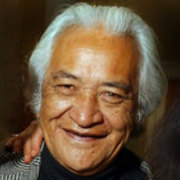
Wi Kuki Kaa
While not big in stature, Wi Kuki Kaa was a formidable presence on the New Zealand stage and screen for almost 30 years.
Born on December 16, 1938 in Rangitukia, he was one of 12 children of Anglican vicar Reverend Tipi Whenua Kaa and Hohipene Whaanga. The family, whose whakapapa embraces Ngāti Porou, Ngāti Hokopu, Te Whānau a Hunaara, Rongomaiwahine, Rakai-Paaka, and Kahungunu, was raised with poetry, books, and stimulating conversation held in both Māori and English.
Several of his siblings have made significant contributions in other fields — brother Hone Kaa in the Anglican church, and sisters Keri Kaa and Arapera Blank as writers and educators.
Wi Kuki attended Te Aute College and Victoria University, where he became interested in drama — and the notion that acting was much easier than working in the freezing works. His flatmate Paul Maunder has argued that his first acting role came about after Maunder invited him "to play god" in a one-act play.
A drama about a freezing works later provided him with one of his most notable roles: as Iwi in Ngāti (1987), the Barry Barclay-directed classic set in the 1940s, in the East Coast Ngāti Porou heartland where Wi Kuki grew up. He was judged Best Male Performer at the 1988 New Zealand Film Awards. In a rave review, Herald writer Peter Calder described Wi Kuki's performance as "a ridge pole from which all the impossibly delicate structure radiates . . . beyond praise". Wi Kuki talks about Ngāti in this Kaleidoscope piece.
Wi Kuki spent much of the 1960s and 70s in Australia, playing Aboriginals, Orientals and ethnic villains in television series like Homicide and The Sullivans.
In 1969, he played the role of an African American homosexual in the Australian version of Mart Crowley's stage play The Boys in the Band, about the life of a group of gay men. His brother Hone Kaa says producer Richard Campion (don of Wellington theatre), had talked Wi Kuki into taking the role, which for its time was incredibly risque. Hone went to see his brother perform it in Sydney: "I asked him 'how the hell did you land the part?' His memorable line to me was, 'I don't look like a negro, I don't talk like one, I don't walk like one, but I can play the part of a homosexual very easily'. As only Wi Kuki could say."
Wi Kuki returned home to play Chief Rewi Maniapoto in TV epic The Governor (1977) and the soldier Wiremu in Geoff Murphy's historical epic Utu (1983) - Wi Kuki features in the memorable opening scene. His relationship with director Barry Barclay continued through his role as lawyer Rewi Marangai in Barclay's ambitious second feature Te Rua (1991).
Other roles included short films Te Po Uriuri (2001), Taniwha - Water Spirit (1996) and award-winning Front Lawn tale Linda's Body (1990). He played the Tahitian king whose daughter falls for Fletcher Christian in Roger Donaldson's version of The Bounty, and appeared in TV series Te Kai a Te Rangatira and Worzel Gummidge Down Under. He also starred in 2003 short Turangawaewae, as a homeless Vietnam War veteran jolted into visiting his ancestral home by his daughter (Nancy Brunning). Turangawaewae won a script award for writer Wiremu Grace, and was selected to play at the Cannes Film Festival in France.
Off-screen, his talents were similarly prodigious: he performed Henrik Ibsen's An Enemy of the People; composed bicultural opera Taku Wana - the Enduring Spirit with Helen Fisher; and wrote short stories and other literature. While tamariki nowadays may not be familiar with Kaa's presence and mana, his work recording stories for school publications ensures that his distinctive voice will echo for years to come.
Along with Barry Barclay and Anne Keating among others, Wi Kuki was a member of Te Manu Aute, a collective which pushed for Māori communicators to win a measure of control in their chosen crafts. He also served as a trustee of Ngā Taonga Sound and Vision for many years when it was known as the Film Archive, following time spent on an advisory group convened to help the organisation develop its bicultural mission.
From a serene performance in the music video for Trinity Roots' 'Little Things', to his final role as Old Rangi in Vincent Ward's River Queen, part of Kaa's talent lay in his ability to bring a watchable, understated intensity to the projects he was involved with.
One of Wi Kuki Kaa's last projects was as rangatira Te Keepa Rangihiwinui in the play Dr Buller's Birds - Survival of the Fittest. The role was written for him by Nick Blake, and Wi Kuki helped develop it through an extensive workshop process. However illness intervened, and he was replaced by Rawiri Paratene.
Paratene wrote about Kaa in an obituary in Onfilm. "Wi Kuki died just a few days before we opened the play. We dedicated the season to him and on opening night we left his seat vacant, decorated simply with a fern leaf. I felt a lovely irony performing to a seat that had been reserved for an elder who didn't make it ... Wi, you were a great actor with your best work ahead of you — a great way for an actor to go out perhaps. Your wit, intellect, cheek, and mana will be sadly missed!"
Wi Kuki Kaa died on 19 February, 2006.
Moe mai e te rangatira, moe mai.
Profile updated on 10 October 2025
Sources include
'Wi Kuki Kaa' (Obituary) - Onfilm, March 2006, page 27 (Volume 23, Number 3)
Peter Calder, review of Ngāti, 1987
Palu Maunder, Performer - A Memoir (2021; Blackball, Te Puawai Cooperative Society)