00:00
/
00:00
Moa's Ark : Building the Ark
Television (Full Length) – 1990
This was just too good for a botanist to miss, a mountain that's falling apart and all its moving scree, smashed-up rocks, is home to plants that grow nowhere else on earth. And this is one of them, a buttercup with the strange name of Ranunculus haastii.
– David Bellamy on a few unique plants of New Zealand in part five
The most recent volcanic display took place only a few hundred years ago on an island called Rangitoto out in the bay.
– David Bellamy on the Rangitoto volcano in part two
At least 300 years later, Rangitoto remains an inhospitable place on which life is still finding a tenuous foothold; the pioneers are lichen and pōhutukawa, the seeds of the tree are able to germinate in damp crevices down in the rock.
– David Bellamy on Rangitoto's rugged landscape in part two
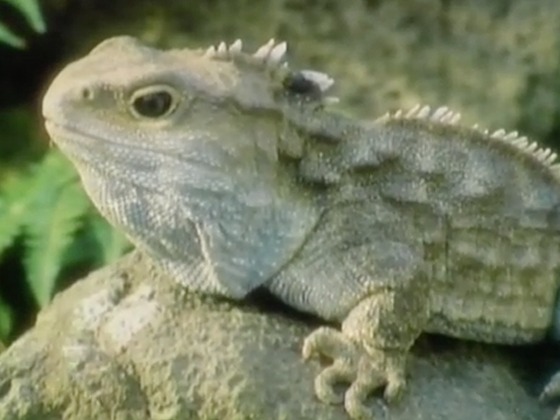
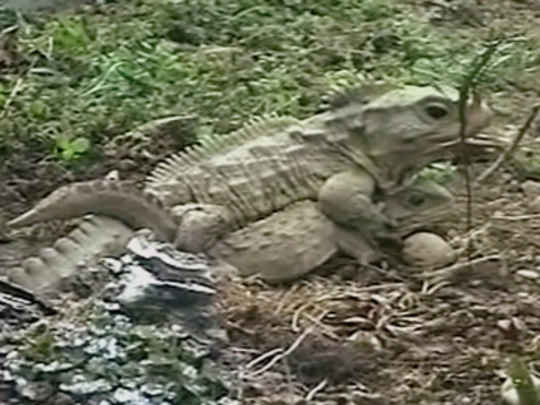
Most of the beak-heads, like the dinosaurs, disappeared millions of years ago, but not the tuatara. It's a living fossil that has been on board Moa’s Ark since its formation and will have witnessed every stage of its epic voyage. Now, wouldn't it be marvellous if we could look at the past through the tuatara’s eye?
– David Bellamy on the tuatara in part one
Early last century, a parcel was rushed to London from the other side of the world. It was delivered to the British Museum of Natural History and was addressed to the man who later went on to become its director, Sir Richard Owen. His parcel contained a single bone, but it was enough for Owen, an eminent paleontologist, to deduce that it belonged to a giant bird, and that’s how the world first came to know of it’s biggest bird: the moa, from New Zealand.
– David Bellamy on the discovery of the moa in part one
Modern farming has replaced natural diversity with monotonous uniformity. Where are all the plants and animals that used to live here? Squeezed almost out of existence into odd corners.
– David Bellamy on the impact of modern farming in part five
If you liked this, you might also like...
Moa's Ark
Why is New Zealand's landscape and flora and fauna so...

Christchurch
As a showcase history of Christchurch onscreen this...
Across the Main Divide
Another main divide crossing
Primeval Survivors
NFU short film on tuatara
The Glacier Climbers
Another journey across the Southern Alps from West to East

Lynn of Tawa - In Search of the Great New Zealand Male
Robin Judkins also features in this doco
The Mighty Moa
A documentary on the extinct giant moa
Seven Black Robins
Another classic from TVNZ's Natural History Unit
The Snowline is Their Boundary
A 50s NFU film about sheep farming in the Southern Alps
Volcanic Fury - White Island
A visit to White Island
Primeval New Zealand
Another NHNZ show featuring tuatara
Weekly Review No. 267 - Winter Sports at Mount Cook
Promotional film about recreation at Aoraki/Mt Cook
Tongariro National Park
A 50s promo showcasing Tongariro National Park
Moa's Ark : Invaders of the Last Ark
The second programme in this series
Wildlife of the Mountains
Earlier nature doco style from NFU
Under the Mountain - Full Series
Volcanoes feature in this classic sci-fi show
Looking at New Zealand - White Island
More ring of fire geology lessons
Legend of Birds
Little Barrier Island features in this 1962 documentary
Love in Cold Blood
A short documentary about tuatara