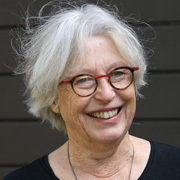
Gaylene Preston
Gaylene Preston began in film by accident, while trying to give a voice to those that didn't have one. She was working at a psychiatric hospital near London. Since many of the patients couldn't talk, the idea of drama therapy did not at first seem a very useful idea. A friend proposed shooting a film instead. Preston found that the film, the first of many, offered these "people who everyone ignored" respect, and a public voice.
Preston grew up in Westport, and then Napier. In Westport, her father ran a fish'n'chips shop, before her parents took on a milk delivery run in Napier. "Drawing, writing, escaping into a story" — and making things up — provided an escape into somewhere more interesting. Preston was "a radio kid". At age three she was asked to recite a poem on local station 3YZ. Later she and her sister Jan acted in radio plays. During piano lessons she encouraged her teacher to tell stories, including about the 1931 Napier earthquake. Collecting oral histories would grow "from a childhood history into a lifelong habit".
After leaving school, Preston did three years at Ilam art school, then seven years in England. She returned to New Zealand in 1977, and joined the team of young filmmakers working for John O'Shea at Pacific Films in Wellington — a place whose spirit of creativity reminded her of "Walt Disney's garage in about 1938". There she did animation, and directed two items for short-lived programme Shoreline.
When Pacific made one of its many staff cutbacks, Preston combined stints as an art director and director, with freelance cartooning and photography. She worked closely with cinematographer 'Waka' Attewell to make award-winning documentary short All the Way Up There (1979), which chronicled the struggle of quadriplegic Bruce Burgess to reach the top of Mount Ruapehu. When the film played in Kiwi cinemas alongside movie Middle Age Spread (which she incidentally worked on as art director), theatre managers complained that viewers were feeling too emotional to get snacks during intermission.
Preston explored people who find themselves outsiders in two more projects: Learning Fast (1980) which chronicles life and looming unemployment for a group of teens, and drama meets documentary Hold Up, in which three so-called 'disabled' people witness a crime. In her own time, Preston was using her video camera to document friends, family and anti-nuclear protests. She also directed this ambitious three in one music video, and Making Utu, which went behind the scenes on Geoff Murphy's 1983 Western.
After meeting Robin Laing, then partner of director John Laing, Preston decided that Robin had all the right qualifications to be a film producer. The pair formed Preston Laing Productions, and as Preston recounts in this video interview, found themselves at meetings where people would continue to look at the door after they had sat down. "It gradually dawned on us that they were waiting for the man to come in, and we had to say: 'Well there isn't one. You'll have to talk to us.'"
The Preston Laing team would go on to work together on Mr Wrong, Ruby and Rata, War Stories Our Mothers Never Told Us and Perfect Strangers. Preston and Laing have been strong advocates of equality within the industry, and role models for a number of emerging women filmmakers.
Mr Wrong (1985), Preston's feature film debut, was partly an attempt to avoid genre conventions of sexism, glamour and cultural vagueness. Based on a short story by English writer Elizabeth Jane Howard, the movie follows a Kiwi woman (Heather Bolton) whose car may be haunted. The film undercuts thriller conventions that the woman must always get rescued by Mr Right. After facing disinterest from local cinema chains, Preston successfully rented out cinemas, proving that the film had an audience. In the United States Mr Wrong was retitled Dark of the Night, where critic Judith Crist called it a "dandy little thriller marked by excellent performances".
There was a five-year gap before Preston's next feature, during which she had a child, and was commissioned by Thames Television to make a documentary about writer Keri Hulme (Kai Pūrākau - The Storyteller). Preston argued that Hulme's work offered "a bridge and insight into the past and present" of two older cultures.
Originally conceived as a television series, Ruby and Rata is a crosscultural comedy about an old Pākehā woman, a young Māori solo mother, and her son. Preston bought a house in the Auckland suburb of Mt Albert to film it in, which was later sold for $30,000 more than the purchase price. Written by Preston's longtime writing collaborator Graeme Tetley, Ruby won five awards at the 1990 NZ Film Awards. She went on to make Married, her first drama for television.
Preston's next two projects made nods to the past. Miniseries Bread and Roses (1993) dramatises the formative experiences of social activist and politician Sonja Davies. Keen to make a fictional film based around the World War ll period, Preston and Laing soon realised that Davies' autobiography had the qualities they were looking for. Australian Genevieve Picot's portrayal of Davies won wide acclaim.
An early Kiwi documentary to win a theatrical release, War Stories Our Mothers Never Told Us (1995) features a group of women recalling their experiences of World War ll. Highly acclaimed locally and abroad, the film was inspired partly by Preston's mother Tui, one of those interviewed. Preston has said that having grown up in the aftermath of the war, "the stories that I heard around my mother's skirts were stories of the war". War Stories had its European premiere in the official selection at the 1995 Venice Film Festival.
Over the next few years Preston concentrated on documentaries, directing Hone Tuwhare, Getting to Our Place (alongside Anna Cottrell — about the creation of Te Papa museum), and Titless Wonders (about women who have experienced breast cancer).
With twisted romance Perfect Strangers (2003) Preston revelled in the chance to create her own story. Sam Neill and Australian Rachel Blake play two strangers who meet. The film returned to Preston's beginnings in the thriller genre; her intention was to see how far she could push the conventions of genre storytelling. Perfect Strangers won some ecstatic reviewers overseas, though Kiwi reaction was mixed; some argued that the negative reviews were largely written by males.
Preston's next feature was Home by Christmas, based on her father's memories of serving in WWII, and her mother Tui's life on the home front (as recounted in War Stories). The film began from ten double-sided cassette tapes of interviews with her father. Released in New Zealand in late April 2010, the film stars Goodbye Pork Pie's Tony Barry, Martin Henderson, and Preston's own daughter, Chelsie Florence. A 'making of' documentary can be viewed here.
Preston went on to co-direct award-winning docu-drama Strongman: The Tragedy (this time with Paula McTaggart), about the 1967 Strongman mine disaster. Preston had earlier explored the 1931 Hawke's Bay earthquake in this 1998 short film and this Qantas-nominated documentary.
After working on Strongman, Preston spent extensive time in Christchurch researching Hope and Wire (which is viewable in full here). The miniseries debuted on TV3 in mid 2014. Following a range of Christchurch characters during and after the 2010 and 2011 quakes, it includes scenes where characters address the audience directly, and music from Lyttelton band The Eastern. The Herald's Michele Hewitson found the result clever and compelling, "a love letter to poor battered and shaken Christchurch, and a lament". Preston advised Christchurch viewers not to watch it.
Next came My Year with Helen. The documentary follows former Prime Minister Helen Clark over a year-long campaign to become the first female Secretary General of the United Nations. Filming in and around the UN's New York headquarters, where Clark worked, provided many challenges. Preston often operated the camera herself. The film chronicles Preston's fascination with the workings of power, and her belief that at the UN many clever and well-meaning people "are forced to operate within an antiquated system". The film got its world premiere in June 2017, in the Special Presentation strand of the Sydney Film Festival.
Preston has also created projects for the Auckland War Memorial Museum, including this film about women getting the vote and war-themed archival films, which were projected on the outside walls of the museum around Anzac Day.
Preston's work has won a range of New Zealand screen awards (including Best Film for War Stories) plus international advertising awards — including a Silver Cannes Clio and Mobius Award (Chicago) for outstanding direction of a commercial. Her films have been selected for major film festivals including Venice, Sundance, Toronto, and Melbourne.
In 2001 Preston became the first local filmmaker to be named a Laureate by the NZ Arts Foundation. In 2016 screen organisation SPADA gave her an Industry Champion Award for "her significant lifetime commitment" to local film and television. Two further accolades followed: an award for Services to Cinema at the 2017 NZ Film Awards, and being made a Dame Companion of the NZ Order of Merit (she was named an officer of the order in 2002). On becoming a Dame, Preston said she was proudest of having raised a child while following her creative talents.
In 2022 Preston charted her filmmaking journey — and changing times — in autobiography Gaylene's Take - Her Life in New Zealand Film. An excerpt from it is featured in NZ On Screen's Gaylene Preston Collection. Preston also gets a chapter in Film in Aotearoa New Zealand (1992), Filling the Frame (1992) and New Zealand Filmmakers (2007).
Profile updated on 18 December 2022
Sources include
Gaylene Preston
Gaylene Preston, Gaylene's Take - Her Life In New Zealand Film (Wellington: Te Hereenga Waka University Press, 2022)
Gaylene Preston Productions website. Accessed 18 December 2022
My Year with Helen website. Accessed 28 November 2022
'Director Gaylene Preston on making NZ Films' (Video Interview), NZ On Screen Website. Director Ian Pryor. Loaded 20 October 2009. Accessed 31 December 2018
Merrill Coke, 'Low Budget High Profile (Interview) - Onfilm, June 1986, page 17 (Volume 3, No 4)
Michele Hewitson,'Why 'Hope and Wire' is so compelling' (Review) - The NZ Herald, 4 July 2014
Roger Horrocks, ‘New Zealand Film Makers at the Auckland City Art Gallery: Gaylene Preston' 1984
Rebecca Macfie, 'Canterbury tales' (Interview) - The Listener, 5 July 2014, page 34
Karoline Tuckey, 'Arise Dame Gaylene Preston' (Audio interview) Radio New Zealand website. Loaded 31 December 2018. Accessed 8 January 2019
Unknown writer, 'Kai Purakau' - Wellington International Women's Film Festival programme, September 1988
Unknown writer, '19th Annual SPADA Industry Award Winners Announced' (Press release), 24 November 2016
My Year with Helen press kit