00:00
/
00:00
Outrageous Fortune
Television (Excerpts) – 2005 - 2010
A Series Perspective

In the world of television, there are unspoken codes. Expensive clothes are important. Losers get voted off, so the audience won't have to look at them. Forensic testing takes only a few quick-cut minutes. And criminals spill the beans, in time for the closing credits.
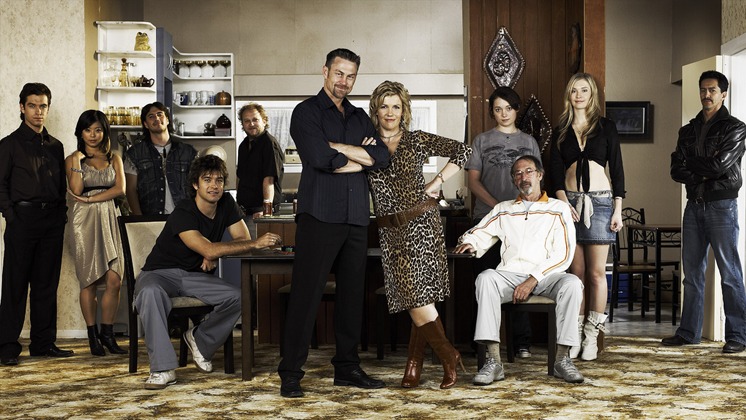
If the family in Outrageous Fortune had followed the code, they would have been packed off to broadcasting's equivalent of Paremoremo, right after the first episode played in 2005. But the West family has their own code. They may variously blackmail, rob, wag school, pretend to be their own twin brother, and bed other people's partners. But there are certain lines you don't cross, like no violence, no dobbing in others, and no invading people's houses (well not when they're at home anyway).
At the end of Outrageous Fortune's first episode, matriarch Cheryl West announced to her incredulous family that the code was about to get tighter still — from now on, the Wests wouldn't be engaging in crime at all.
As scriptwriter and creator Rachel Lang says, "the Wests are all about values, and what is or is not moral — though it may not be always obvious."
The family's struggle to stay on the straight and narrow took New Zealand television into new and unusual places, placing them amongst the great dysfunctional TV families (The Sopranos, Married with Children).
Outrageous Fortune began life partly because Rachel Lang was keen for a brasher, funnier take on the white trash family she had created for Mercy Peak. Lang had also been mulling over other questions: among them why more mothers weren't engaging in crime when the median income for New Zealand women was only $14,000 a year, and how marriages might be affected as women change and seek something more than being a housewife.
Lang and longtime collaborator James Griffin (Serial Killers) went west and set about creating the heart of the show: feisty but well-intentioned Cheryl West (Robyn Malcolm from Shortland Street and Serial Killers), trying to do the best for her family.
That family starts with Cheryl's charismatic, troublemaking husband Wolfgang West (Australian Grant Bowler) who, aside from a spell of home detention in series two, spends much of the storyline incarcerated, or missing in criminal action.
The rest of this family of largely likable rogues comprises a troublesome Grandfather (the latae Frank Whitten of Vigil and Speights 'good onya mate' commercial fame); two sets of chalk and cheese offspring: conniving lawyer Jethro and his twin brother, the kindhearted but gormless Van (both roles played by Antony Starr in award-winning performances); and younger sister Pascalle (Siobhan Marshall), the outwardly ditzy aspiring model turned entrepreneur, and the youngest of the family, budding business mastermind Loretta (Antonia Prebble).
Throw in a revolving cast of suitors, including Cheryl's police tormentor turned lover (Kirk Torrance), and you get an entire cast that fit their roles like a glove.
Griffin and Lang marshal a crew of directors (including Mark Beesley, Simon Bennett, Britta Johnstone, Murray Keane, Michael Bennett and Peter Salmon) and writers (Tim Balme, Kate McDermott and Gavin Strawhan amongst others) to show the Wests at their best, whichever one of them is acting their worst. Their consistent excellence over six seasons was remarkable given the high-turnaround demands of television drama.
This heady brew of suburban mayhem proved a ratings success from its first season; by 2007, audiences had grown to the point where it was TV3's third most popular programme of the year (behind the Rugby World Cup and CSI).
When the sixth and final season ended in November 2010, the show's accumulated 107 episodes made it New Zealand's longest running drama series. With a stack of rave reviews and more than 40 awards — including four Film and Television gongs for best drama — it also ranks as one of the most decorated.
As well as broadcasting the original, other countries paid to remake the show. Remake rights to the Outrageous Fortune concept were sold to America — in a first for Australasian drama — as well as England, Spain and Italy. This is a remarkable achievement in an industry which has often simply pasted overseas stories onto local scenery.
Kiwi television dramas have often taken the safe road, aping genre formulas and avoiding the risqué. The team behind Outrageous Fortune dived gleefully into oceans of sex, swearing, sabre-rattling and moral conundrums, right from episode one in July 2005.
Brash the show could certainly be, occasionally even over-enamoured of its own shock value. But don't let that blind you to Outrageous Fortune's rich characters; to clan leader Cheryl's no-nonsense strength under pressure; and to the confidence with which the show swings from tragedy to farce, then back to, if I may be so blunt, tits and ass.
The show's intentions re flagged right from the Hello Sailor title song ('Gutter Black'). The programme's original working title may have been White Trash, but there's nothing condescending about the way the characters are treated.
Those characters deepened along with the series, often in unexpected ways. Longtime viewers were left speculating over who can be trusted, and on what day. Sometimes the contradictions and about-turns are storytelling masterstrokes — like the moment the door creaked briefly open, and onetime uber-villain Loretta was suddenly revealed for the sad, lonely creature she then was. Plotlines which saw dramatic relationship turns for both Van and Kasey packed a genuine emotional wallop.
Each episode's name is taken from Hamlet; the arrows of Outrageous Fortune were slung gleefully across the lawns and rumpus rooms of West Auckland. Amongst the theatrics there's a down to earth reason for Outrageous Fortune's widespread popular affection; like Hamlet, it's all about family. Says creator James Griffin: "They're a family who are passionate, lusty and they live life to the full ... they can say and do the things that we all think and wish we could say and do."
Six wonderful seasons. So much to savour. Van and Munter, one of New Zealand's great comedy double acts (Munter even won his own ‘Munter is Choice' fan club). Pitch-perfect use of the New Zealand pop music songbook, right down to the last scene. A Christmas special that wasn't awful. And another miracle: Westside, a prequel series that is actually worth watching in its own right.
- Ian Pryor is Editor of NZ On Screen.

If you liked this, you might also like...

Gloss - First Episode
A drama series from the 80s
Mercy Peak - First Episode
Also produced by John Laing and South Pacific Pictures
Double Booking
James Griffin also created this
Serial Killers - Full Series
Series featuring Robyn Malcolm
Intrepid Journeys - Vietnam (Robyn Malcolm)
Robyn Malcolm travels to Vietnam
Reflections - Gretchen Albrecht
Also edited by Bryan Shaw
The Marching Girls - Mahara's Story
Featuring Outrageous Fortune creator Rachel Lang as an...
Tagata Pasifika - The Naked Samoans
Featuring Dave Fane as a Naked Samoan
Savage Honeymoon
More working class West Auckland families
Shortland Street - 1995 Christmas cliffhanger (truck crash)
Also starring Robyn Malcolm
After the Waterfall
Antony Starr stars
The Hopes and Dreams of Gazza Snell
Also starring Robyn Malcolm
Gutter Black
Hello Sailor performance of the Outrageous Fortune theme
Spin Doctors - Election Special
Also written by James Griffin
No. 2
Anthony Starr also acted in this