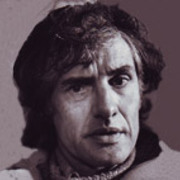
Paul Maunder
Paul Maunder was born in Napier in the final year of WWll. He was invited to play piano at social events, and went on to captain the school cricket team. After falling for a girl who was starring in Antigone, he was "knocked into feeling" and his longtime love of theatre.
When he asked his parents for his birth certificate, so that he could start a Bachelor of Arts, Maunder learned that he was adopted, and that his birth mother had disappeared during one of many attempts to escape from Porirua Mental Hospital.
After graduating from Victoria University, Maunder used a 1000 pound inheritance to relocate to Australia and study at the National Institute of Dramatic Arts (NIDA). Unfortunately the "small directing" component of the course was mainly about stage management. Next came a year at the London Film School, beside students from many nations. Caught up in the excitement of being on the ground during the countercultural sweep of the 1960s, he wrote a monologue for his wife, actor Denise Maunder. Birthday, the result, won an award at the Berlin Film Festival.
The couple were back in New Zealand, working again as teachers, when Maunder heard back from government filmmaking organisation the National Film Unit. So began a five year period working at the Unit, which he describes here. In that time he completed 10 films, including a trio of dramas featuring a strong element of improvisation, and distinguished himself as a filmmaker who refused to do things by the book.
The NFU's vision of the Commonwealth Games, Games 74, was screened throughout New Zealand cinemas. Maunder was one of a team of four directors, and also helped edit; the film attracted polarized comments for its sometimes downbeat imagining of the sporting spectacle.
In 1971 Maunder's screenplay for TV, a drama titled Saturdays, won the Ngaio Marsh TV Playwrights Award.
The opportunity to direct one of his own scripts came the following year, when the NZ Broadcasting Corporation's "visionary" Head of Drama Michael Scott-Smith began commissioning a number of independent productions. Gone Up North For A While (1972), a story of a young unmarried woman's struggle with an unplanned pregnancy, proved to be one of the most memorable.
Made in a naturalistic style, with much use of improvised dialogue, the Feltex Award-winning drama presented some challenges. "Buying props and costumes required an emergency work order signed by the minister," recalls Maunder, "which reduced spontaneity a little, and recording synchronised sound was then a novel thing (a young Don Reynolds did that job)".
The drama featured Maunder's wife Denise Maunder and Paul Holmes. It was widely seen and discussed, at a time when parliament was debating introducing a domestic purposes benefit for unwed mothers. A year or so later, the bill was passed into law; Maunder says that cabinet minister Martin Findlay later told him that Gone Up North had helped create a climate which enabled legislative change.
Scott-Smith then commissioned Maunder to make One of those People that Live in the World (1974). This time Maunder chose mental illness as his subject. "After copious research including spending time a mental hospital, I wrote a two-part script," he recalls. "It was a big job for the five person crew (including myself), for the second part required setting up a mental hospital. Unthinkable now, but sort of fun. Everyone did everything."
Feature-length experimental drama Landfall (1975) began as "a study of the commune impulse", but drifted off "into more of a tele-feature, with some reference to the settler culture. It became something of an arthouse film I suppose". The ensemble cast featured fellow NFU director, Sam Neill, future TV director John Anderson and Jonathan Dennis, who would go on to found the Film Archive (now Ngā Taonga).
Landfall had been funded by state television; Maunder took their refusal to screen it as a sign that local television was increasingly "pandering to stupidity", despite the recent addition of a second channel. Instead Landfall screened at festivals here and overseas (including the Pacific and Asian Film Festival in Shiraz), where it won the top award, the Golden Ibex. Unfortunately the film was never widely distributed, and so was little seen in this country.
By that point, Maunder had left the film unit to devote more time to theatre. Occasionally he worked on soap Close to Home, "brain dead directing" that paid well. In 1971 he had been among those who launched theatre company Amamus Theatre Group. The desire was to find a "less hierarchical, more communal way of doing theatre". Some of the group acted in Gone Up North. Later Amamus were invited to perform at an international festival of ‘free theatre' in Poland, and at the Institute of Contemporary Art, London.
Sons for the Return Home (1979), based on the novel by Samoan writer Albert Wendt, was the first feature to examine the experiences of Pacific Islanders in contemporary New Zealand. Shot in New Zealand, Western Samoa and London, the film chronicles life for Sione (Uelese Petaia), who moves downunder at age four. Later, at university, he meets a palagi woman. The film's lead actor Uelese Petaia was "a linesman for a power company," and Maunder later found more castmembers when he went location hunting in Samoa. A hotel cleaner played the prophetess "with style".
Petaia won an acting award in Czechoslovakia. Locally the film played in main street cinemas.But afterwards, Maunder realised that he was better suited to the state-funded screen industry that existed in many parts of Europe, than the profit-driven model he felt was gaining ground in New Zealand.
Maunder has written or developed more than 15 plays. Many have historical and bicultural themes: Goodnight, Irene was triggered by the Pike River disaster (as was Maunder's book Coal and the Coast); Death (and Love) in Gaza was born from the 2003 death of an American protestor by an Israeli bulldozer. Theatreview's John Smythe praised the way Maunder and the cast "were able to convincingly evoke an historical context and subjective experience" most viewers would never confront firsthand.
Maunder's short story collection Tornado was published in 2009. The title story — which mixes a real life tornado and a Greymouth video shop — won the South Island Writers Association Short Story competition. His 2011 PhD thesis on community theatre in New Zealand led to 2013 book Rebellious Mirrors: Community-based Theatre in Aotearoa/New Zealand, published by Canterbury University Press.
He has also produced community videos, and developed some as-yet unrealised drama projects, including a historical film set in Taranaki. After working on a theatre project in Tokelau, Maunder began developing a feature project about a New Zealand-born Tokelauan heading back to the island. In his book Maunder argues that the project was turned down for funding because of its social and environmental themes.
After buying an old miner's cottage on the West Coast for around $10,000, he worked on the house for several years on holiday breaks before moving in. Maunder's 2021 book Performer - A Memoir mixes memory, self-analysis and imagination to distinctive effect.
Profile updated on 10 October 2025
Sources include
Paul Maunder
Paul Maunder, Performer - A Memoir (2021; Blackball, Te Puawai Cooperative Society)
Paul Maunder, 'An organisation open to new things' NZ On Screen website. Loaded 29 July 2010. Accessed 11 October 2025l
'Paul Maunder' Playmarket website. Accessed 10 October 2025
John Smythe, 'Compelling Authenticity' (Broken link - Review of Death (and Love} in Gaza) Theatreview website. Loaded 25 July 2006. Accessed 27 July 2016