00:00
/
00:00
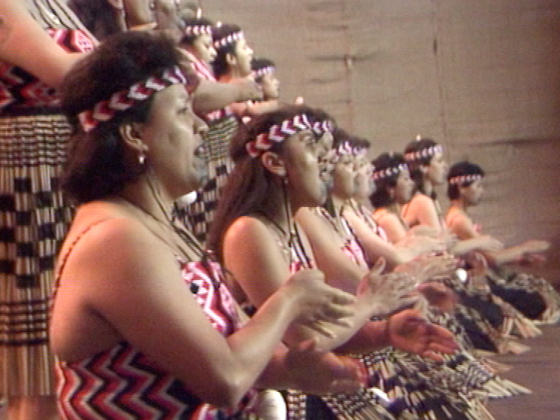
Waka Huia - First Episode
Television (Full Length Episode) – 1987
Mehemea kei te kī tātou he Māori tātou. Kāore tātou e mōhio ki te reo. Ehara kē tātou i te Māori. / If we say that we're Māori, and if we do not know the language: we're no longer Māori.
– James Hēnare
Kei roto i taku hinengaro i roto i taku whatumanawa e pēnei ana 'Mā te whaimana rā ānō o te wahine, kātahi anō te iwi Māori ka maranga.' / My mind and my heart go 'It's only when women are recognised will Māori wake up!'
– Mira Szászy
Our elders, who had the stories we wanted, refused to talk on camera . . . We kept getting refusals until we took a punt and took our team and their equipment to Waitangi in February 1987. After a few knockbacks from some of the kaumātua [elders], Sir James Hēnare, the well-respected elder from the north, agreed to talk to us . . . Dame Mira Szaszy, President of the Māori Women's Welfare League, approached us and said, 'If it's good enough for Sir James, I'll talk — if you think I might make a contribution.'
– Whai Ngata, on the importance of getting James Hēnare to agree to an interview, in his backgrounder
I was in the back row during that performance … I shot out of the directors seat in the Outside Broadcast van to get backstage and join the group.
– Waka Huia director Tainui Stephens on both working on and performing in this episode
Waka Huia was conceived as a television taonga to be as precious as the name implied.
– Waka Huia director Tainui Stephens writing about the show, in his backgrounder
If you liked this, you might also like...
Waka Huia
A 'waka huia' is traditionally a treasure box to hold...
The Matariki Collection
A selection of iconic Māori TV, film and music video for...
Tangata Whenua - Waikato
Landmark documentary series on Te Ao Māori
Te Māori - A Celebration of the People and their Art
Features another interview with James Hēnare
Marae - 2008 Election Special
The 2008 election special of long-running series marae
Pounamu - Tahupōtiki Wiremu Rātana
Another show about iconic Māori people
50 Years of New Zealand Television: 7 - Taonga TV
A history of Māori television programmes
Koha - Te Māori, A Cloak of Words
James Hēnare also features in this documentary
Koha - Te Māori Guard, New York
Long-running Māori TV series covering all things te ao...
Waka Huia - Hirini Melbourne & Te Puka a Maui
Another early episode from this series

Te Pāmu Kūmara - First Episode
One of the first te reo Māori scripted dramas for tamariki
Let My Whakapapa Speak
James Hēnare also features in this documentary
National Treasures - Excerpts
Another show preserving New Zealand history
Te Māori - A Celebration of the People and their Art
Features another interview with James Hēnare