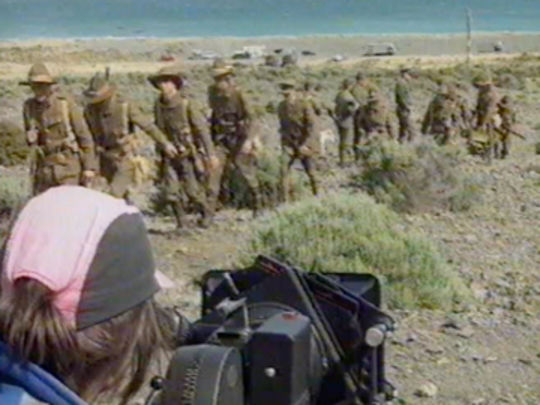
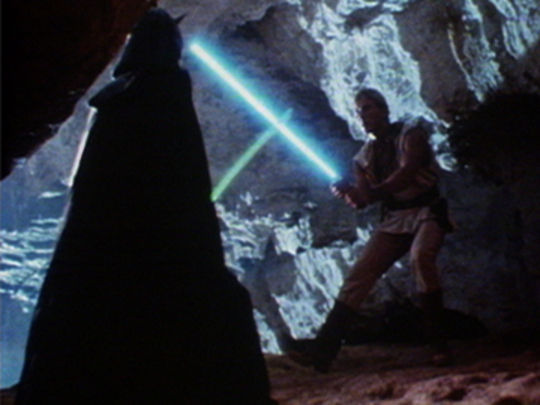

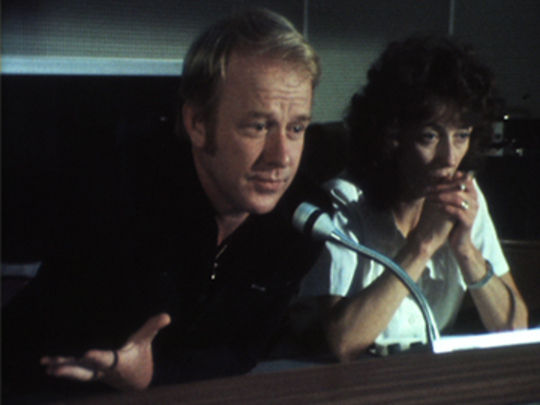
Behind the Scenes Collection
Behind the Scenes Collection
This collection has two backgrounds:
The Motley Bunch
Learning by Doing
The Motley Bunch
By Toa Fraser 19 Jun 2025
The trucks arrived last night. Just as the sun went down, cones appeared. Now the full moon is still strong in the early morning sky, and the trucks show no sign of activity, save for the lone security guard standing on the pavement wearing his hi-vis. The rubbish truck is going to have a tricky time on the street around the corner, where the film crew vans and tracks are beginning to take over.
They are doing splits this week — which is to say, they have breakfast around 10.15am, lunch around 3pm, and shoot into the night. This time of year, nine days from the shortest day of the year, suits split shoots. You can get a good amount of night shooting done, and still go home at a reasonable hour. Six years ago, in Toronto, I did a day/night split shoot on the summer solstice. The sun went down at about 11pm, and came up again at something like 4am. We were shooting on a beach, and we had to get two tricky dialogue scenes in a short space of time.
Allen Guilford, the great Kiwi cinematographer, introduced me to film sets in 1990. He invited me to go and hang out with him on the set of Old Scores, a comedy about veteran All Blacks playing a rematch of a test against Wales. Alex 'Grizz' Wyllie was in the cast, and All Black prop Steve McDowall was a technical advisor.
A couple of years later, Allen organised me my first real job on a film set, working for Lemani Archibald in the lighting department on a Greg Johnson music clip. At the beginning of the day, Lemani asked me to take some black plastic up onto the roof to black out the skylights, and to take some sandbags to secure them. At the end of the day, he told me to take them down. I went up, and thinking that the most efficient way to get the sandbags down would be to throw them, I did just that. As soon as the first one left my hand, I knew it as a bad idea. It exploded on impact; I was lucky it didn't land on somebody's head.
The 1990s were a giddy time for New Zealand film, with The Piano, Once Were Warriors and Heavenly Creatures all released within a 12 month run. My brief career in the lighting department now over, I went along to try get hired as an extra on The Piano. I was not successful.
In the end, I found my place on the film set, in the least demanding job of all. As a director, I get to stand in the middle of this thrilling circus of practitioners and professionals who have real skills: grips, actors, makeup artists, accountants, ADs [assistant directors], script supervisors, caterers, drone operators, DIT operators, sound recordists, carpenters…the list is endless.

Sunny days, as captured in Toa Fraser's movie No. 2 (2006).
It takes a village — as anyone with a cursory interest in what goes into the production of the things we watch on-screen will appreciate. This collection reflects that. It also conveys the camaraderie, that joyful spirit of a group of wildly different people coming together with a single purpose. It’s key grip Tommy Parks sneakily shouting dinner for the crew in Te Anau (I know it was you, Tommy). It’s cinematographer John Cavill quietly asking his director in the middle of the night if he’s OK (I won’t forget that, JC). It’s Jodi Eruera Sutherland slogging sandbags up and down the dunes at Karekare. Cinematographer Grant McKinnon fashioning beautiful lighting effects on the wall with mirrors from 10 metres away, on what he described as "possibly the sunniest movie NZ’s ever made". (No. 2). It’s costume designer Amanda Neale crafting a beautiful email to her director saying "we all support you". And AD Katie Flanagan high-fiving actors in the backyard.
We are a motley bunch, it’s true. We eat at weird times of the day and night. We wear funny clothes. We work hard, crazy hours, and to many people on the outside (civilians) it’s perhaps difficult to understand why we do what we do. Maybe this collection will help.
Anyway, the sun is now up and across the street, the familiar sound of the clattering of C-stands and gel frames has begun, quite a while before crew call.
A young guy just knocked on our front door. He said he’s from the film crew and found a key on the pavement, and was wondering if it was ours. He’s from the lighting department. It wasn’t ours. I wonder if he will stay in the lighting department. Anyway seeing as there’s a film crew in our neighbourhood, I’m going to go and find the coffee cart. I’ve worked on film sets all around the world, but nowhere does a good coffee cart like a film set in Aotearoa.
- Toa Fraser turned his play No. 2 into his first feature, shot in the Auckland suburb of Mt Roskill. Since then Fraser has directed in locations across Aotearoa, plus LA, Toronto, Dublin, Queensland and the French Alps.
Learning by Doing
By Rob Gillies 19 Jun 2025
'Learn by doing' was the stern admonishment, etched into the plastered arch which loomed above the entrance of my primary school in Whanganui. At least that's how I remember it. They must have known there's nothing like a stuff-up to put you all on the right path. You will join a garage band, make your mistakes...then by degrees get it right!
The same is true of the Kiwi screen industry. Over the decades we've learned by doing, partly by getting more opportunities to get on with the job, as productions have grown in number.
The 1980s was an especially important decade for New Zealanders working in the screen industry, as production ramped up across movies, television and commercials. Through the 1980s and beyond, the number eight wire, garage band approach of the small, multi-tasking film crews of the past began to morph into larger crews, with more defined lanes of craft specialisation.
It was an exciting time: a bumpy but feasible employment scenario developed for many screen technicians. Previously state television and the National Film Unit had been among the only places you could find ongoing work. But now television production was becoming increasingly outsourced, as TVNZ progressively divested itself of its 'high cost' production capability. Newly created, privately-owned channel TV3 cut straight to the chase, using independent production companies for everything other than the news and weather.
On the movie front, as the late 1970s gave way to the 80s, a rise in production was fuelled partly by the 'tax dodge' movies. Tax incentives encouraged investment from within New Zealand and off shore, in the form of co-productions. Movies got made, albeit for a variety of reasons — but they still got made.
On occasion, when a spectacular action sequence or location was scheduled, the film crew found themselves joined by unexpected arrivals at the lunch table: the local dentist or maybe a few 'tourists' who had a more than passing interest in the finances of the production. On those days, the crew lunch was sometimes more lavish than usual.
Another avenue offering relatively consistent employment was the commercial, a niche area which is often maligned. Alongside good rates of pay, commercials offered technicians a chance to further hone their skills while pursuing the finely-crafted images often demanded by offshore producers. That ecosystem of local meeting global also provided opportunities to work alongside visiting cinematographers and directors.
It felt like an Australian cinematographer was often getting added to the call sheet. One time I spent a few weeks creating an archetypical American mid-western bar for an ad showcasing Jim Beam. It was shot by Aussie David Gribble. A few years later, while recreating Burt Munro's legendary shed with Dave for The World's Fastest Indian, our previous work together on commercials meant we could hit the ground quickly. I’m sure those kinds of cross-connections between crew members happened a hundred times over, incrementally helping build a matrix of local expertise.

Roger Donaldson directing The World's Fastest Indian (2005).
If it seemed in the 80s we walked, in the 90s we ran. The garage band had grown into a more assured and versatile orchestra. Continuous employment meant that a critical mass of technicians, across all the craft areas, now got to work at their respective jobs on a daily basis, rapidly becoming more accomplished and professional.
Sometime in the early 1990s, American Rob Tapert arrived in Auckland and set up his company Pacific Renaissance Pictures. The success of Tapert's TV shows — in particular Xena: Warrior Princess — meant that an increasing number of film workers could contemplate 'regular' things, like being able to afford a mortgage, invest in better gear, or take a trip overseas. Peter Jackson's The Lord of the Rings trilogy was another key production in upskilling local crews; a number of the Xena and Hercules team would go on to work on Rings.
Personally, after a decade or more of bumpy freelance work on varied screen gigs, being able to head off down the road everyday as a production designer on Xena and Hercules felt like a novelty that never quite wore off. An added bonus was getting home most nights in time to read a bedtime story to the kids.
As the New Zealand screen industry grew, it also, with a slow inevitability, became more impersonal. Behind the scenes, the larger-sized departments became more siloed — a natural consequence of growth.
I confess to indulging in at times to a certain nostalgia for the garage band years — a nostalgia quickly dispelled by browsing the marvellous NZ On Screen website, and watching productions from that earlier era. Oftentimes the garage band found themselves totally up against it, with just one shot at getting it right. The results could be cringeworthy and predictable — sometimes hilariously so. Back then the budgets were often low. Thankfully working with a team brings its own joys. Back when I had dreams of being a painter, I soon discovered that creating with others was more fun (I even did time in a band, but that's another story).
When we got to recreate Burt Munro’s quarter acre section and shed, for Roger Donaldson's The World's Fastest Indian in 2005, it offered the perfect opportunity to pay homage to Burt, and help anchor the story with real authenticity. It also allowed us to pay a sincere homage to the Kiwi DIY approach, and that noble institution: 'the backyard Kiwi shed', home to many a garage band.
Burt Munro reminds me of another Kiwi who did cool stuff in sheds; someone who grew up just around the corner from me, back in Whanganui. Although he was a few years older than me at school, Paul Callaghan played in the same brass band that I did. One afternoon after school, the future world-ranking physicist blew the back off his father's shed. Bloody brilliant! Arise Sir Paul.
Sometimes I imagine the movie camera as a cyclops: mostly facing the front, engrossed in its task of capturing performance and action, but occasionally looking back over its shoulder at the hard-working film crew, keeping things ticking along. What it sees is a mosaic of tenacity, national character and inventiveness, which has made the screen industry we have today.
- Rob Gillies first got interested in design in his father's garage workshop. He began dabbling in filmmaking while playing horns in Split Enz, then joined South Pacific Television. Since then he has designed palaces, offices and alien-infested caverns...plus a shed or two.