00:00
/
00:00
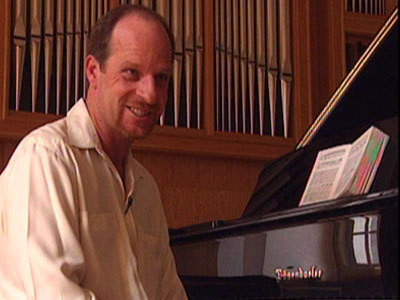
Part one of six from this full length documentary.
Part two of six from this full length documentary.
Part three of six from this full length documentary.
Part four of six from this full length documentary.
Part five of six from this full length documentary.
Part six of six from this full length documentary.
The credits from this documentary.
Icon in B Minor
Television (Full Length) – 1996
I play the music, it resonates inside me. It wakes things up in me, and I think it does that because those things in me are the same as the things that were in Liszt.
– Michael Houstoun on his connection to Liszt in part one
When Liszt was in Weimar, he was absolutely on the cutting edge. He was introducing new music all the time — Berlioz’s music, Wagner’s music. It was all coming here, nobody had heard of this music before and as a result he was perpetually being criticised, put down…
– Michael Houstoun in part one
The sonata, more than anything else, reflects a certain preoccupation of Liszt’s with the idea of transformation. The idea that music, in itself, transforms people who hear music, who listen to it well, has a transforming effect. He argued, too, that the artist who performs music has to transform themself so that the music flows in its best possible way.
– Michael Houstoun on their shared philosophy of transformation in music in part one
I was the most famous man in Europe: the tours, frenzied audiences, the hysteria of so-called ‘Lisztomania’. I lived like a lord but despised the fact that my art was reduced to money.
– Words of Franz Liszt, read by Peter McCauley in part two
I love that he always told them not to look at the piano, that the inspiration would come if they raised their eyes from the keyboard. Such a challenging comment to throw out to people who play the piano, who are usually transfixed on watching their hands.
– Michael Houstoun on Liszt’s surprising advice to his students in part three
If you liked this, you might also like...
Work of Art
This was a series of stand-alone documentaries that...
NZ Music Month
This NZ Music Month collection showcases music television...
Mike Nock
Another musical journey with a legendary Kiwi musician
Michael Fowler Centre Opening - A Festival Concert
Michael Houstoun plays at this concert
An Immigrant Nation - A Little Piece of Deutschland
Another cultural meeting between Deutschland and Aotearoa
Crossing Rachmaninoff
A doco on Kiwi-Italian pianist Flavio Villani
Piano Man
Documentary about Michael Houstoun
Artists Prepare: Chris Cree Brown - Electronic Composer
A documentary about composer Chris Cree Brown
The Piano
A piano has a central role in this film
The New Zealand Wars
NZ wars history doco directed by Tainui Stephens
Farr from Heaven
A documentary about composer Gareth Farr
In Bed with the Orchestra
A documentary on the New Zealand Symphony Orchestra
New Zealand Mirror No. 14
Late Kiwi pianist plays Chopin
Nathan Haines Family Album
Nathan Haines returns home to play with the NZSO
Elgar's Enigma
About English composer Elgar
Te Rua
Another Aotearoa-Deutschland encounter
Margan's Musical Move
A tiki-touring pianist