00:00
/
00:00

The Good Word - Series Four
Television (Full Length Episodes) – 2012
He did ask a question, and that question was, 'Well, who will read your book?' And I said,'Well Māori would'. And he said, 'Well, Māori don't read books' . . . I was astonished and taken aback . . . So, I vowed to myself that I would find a publisher that would not have that same attitude.
– Witi Ihimaera recalls a discussion with someone in the local publishing industry, before the launch of his 1972 short story collection Pounamu Pounamu, in episode one
When you sit down to write a novel, it can be quite intimidating. So for me, Wellington and its streets...it's almost a map of Wellington in the book, and also Lower Hutt. The creeks which form part of the story from Lower Hutt are a kind of physical analog I guess, or a physical way of dealing with a lot of the emotional material of the book.
– Damien Wilkins on the Wellington setting of his debut novel The Miserables (1993), in episode two
...I never really enjoyed training. I always found it rather tedious actually. And there’s no doubt, of all sports, it is probably the most demanding, and boring, because all you’ve got to look at is the bottom of the pool, and up and down you go. And you can’t look at anything: there’s no scenery, you can’t talk. So in some ways, it was probably quite good training for being a novelist, because that’s also a very solitary activity.
– Alex author Tessa Duder on her background as a competitive swimmer, in episode three
Within ten minutes I had had two phone calls: one from a young boy in Auckland who played in a band and saved his money and asked if he could buy a copy of Blinds and Shutters, and said could he pay it off . . . [plus] we’d had a call from somebody, a management operation in Los Angeles, saying that Robert De Niro wanted to buy 10 copies and could we have them freighted to them instantly. So there were two spectrums, totally different.
– David Hedley on publishing Michael Cooper's photography book Blinds and Shutters, in episode four
...I think a poem usually starts out in a condition of ignorance . . . You'd have a certain amount of knowledge, and you also have something that fascinates you. But you don’t know what it is that fascinates you, and that's why you write the poem about it . . . you pursue the thing that you’re trying to write about. So very often, it's like pulling a net in: what have you got?
– Elizabeth Smither on writing poetry, in episode five
I wanted the book to be an entertainment, certainly, and if some people think I'm poking fun, well they can see it that way. I'm not really doing that. But I like to laugh at ourselves, and I include me in that because I'm a New Zealander, and what I'm showing is not different from what we are. It is us . . . It's done with a lot of love.
– Robin Morrison on his photography book From the Road, in episode six
What I wanted to really write about was the difficulties of being a woman and a mother, and all those things, while I was also trying to be a writer, and how I’ve negotiated it.
– Marilyn Duckworth on her aim in writing her book Camping on the Faultline - A Memoir, in episode seven
Initially, I’m writing for myself. I mean, if I were sure none of my books would ever be published, I would want to have written them, because certain problems have always kept me awake at night.
– Professor Jim Flynn on what motivates his writing, in episode eight.
I think it’s a renaissance of interest in our country, and where have we come from? Why are things shifting and changing now? Where are we going? You know, those are big questions, which historians attempt to address, although we’re not crystal ball gazers.
– Claudia Orange on the good timing of her book The Treaty of Waitangi, late in episode nine
...I was working on another novel at the time, when I read an article in the paper about a young woman who was a drug addict who'd died of an overdose. She was Māori and her partner was Pākehā, and the Māori family came down and took the body away, against the specific wishes of the partner. And I just thought 'well that is such a New Zealand story' . . . Immediately I dropped the very difficult novel I was working on, and started writing Settler’s Creek based on that premise.
– Carl Nixon on his second novel Settler’s Creek (2010), in episode ten
Once I had this material, I didn’t want to just make the news for the week. I wasn’t interested in scalps or political things, it actually bores me, it's very passing and not the point . . . I wanted to produce something where any person who read it would kind of get the world, it would have taken them into a completely new place, and they wouldn’t just be subject to the spin and the things that happen after.
– Nicky Hager on his non-fiction book The Hollow Men, about the 2005 National Party campaign, in episode 12
..the publishers are always looking for a hook, and they'd said that I had based this novel on the Mervyn Thompson incident. I had based it on the incident. What actually happened to Mervyn, I make it happen to Howard. But Howard Shag could not be more different from Mervyn Thompson.
– Stephanie Johnson on her novel The Shag Incident, inspired by the real life abduction of playwright Mervyn Thompson, in episode 11
I suppose I like the idea of having a completely feckless main character, who is Reggie Sparks. And I also like the idea of chopping — taking the focus from one character to another, so the reader was never sure what was coming next.
– Paul Thomas on his crime thriller series The Ihaka Trilogy, in episode 13
I was teaching at the time; I had a full-time job. So the short story appealed to me as something that I could encompass in the odd bits and pieces of time that I had available . . . But more importantly, was the fact that I’d always loved the short story. There’s a wonderful one-on-one sense of the literary short story, as opposed to perhaps the blunderbuss of the novel. It's like a single arrow...
– Owen Marshall on what drew him to writing short stories, in episode 14
I wrote an article for our church paper . . . in which I asked what does the Christian doctrine of the resurrection of Jesus mean in the 20th century. And so I indicated that some of the stories of the resurrection were of a legendary and mythical character, not to be taken as history, and that upset them very much indeed.
– Theologian Lloyd Geering on the beginnings of his 1968 book God in the New World, in episode 15
If you liked this, you might also like...
The Good Word
Award-winning novelist Emily Perkins presents a series...

The Good Word - Series One
The first series of this TV show

The Good Word Junior - Series
The children's literature version of this show
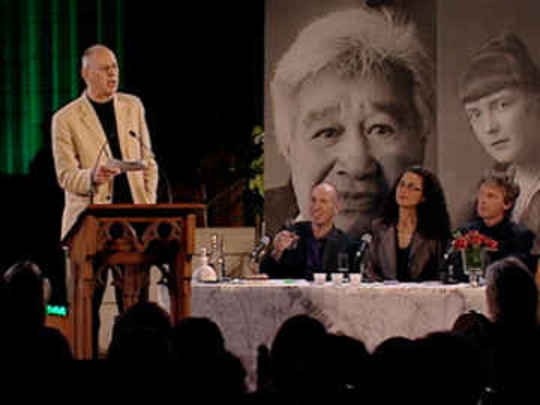
The Good Word Debate
The special debate version of The Good Word
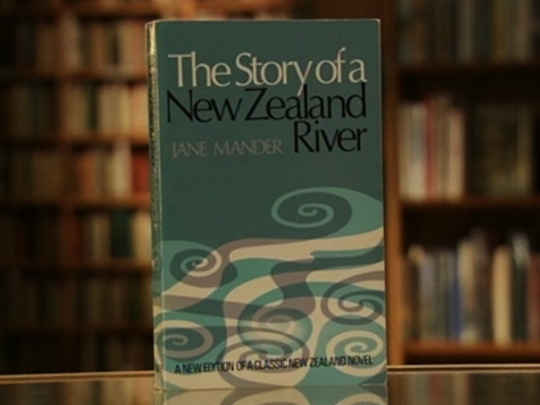
Under the Covers - Episode Three
More literary talk from many of the same team
Witi Ihimaera
1997 documentary on author Witi Ihimaera (episode one)
Global Radar - First Episode
Frequent panelist Te Radar presents his own show
Book to Box Office
More from Tessa Duder (episode three) on her book Alex
Passionless People
Panelist Gordon McLauchlan at his own book launch
The Rehearsal
Eleanor Catton's novel The Rehearsal features in episode...
Paper Boat - Moments in the Life of a Book
Documentary about the process of publishing books
Talk Talk - Series One
Presenter Finlay Macdonald's very own talk show
Jennifer Ward-Lealand: from child actor to busy professional...
An interview with panelist Jennifer Ward-Lealand
Sunday - Daniel Rocks
Frequent panelist Miriama Kamo presenting on Sunday
Carol Hirschfeld: A career on camera and off...
Interview with panelist Carol Hirschfeld
Clare
Episode two Robyn Malcom guest starred in this
Alex
Film adaption of Tessa Duder's novel Alex (episode three)
Carol Hirschfeld: A career on camera and off...
Interview with panelist Carol Hirschfeld
Miriama Kamo: From lifestyle shows to current affairs and back again...
An interview with panelist Miriama Kamo

Lydia
A song by episode six guest Julia Deans
Global Radar - First Episode
Panelist Te Radar in his own show
Shihad - Give It A Whirl Interview
More of episode 11 guest Jon Toogood

Notes from a Fish
Surreal comedy about a desperate writer