Registering with NZ On Screen means you can:
We won't share your data with anyone (see our Privacy Policy) and we won't spam you. It's that simple.
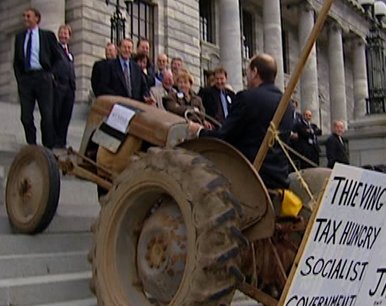
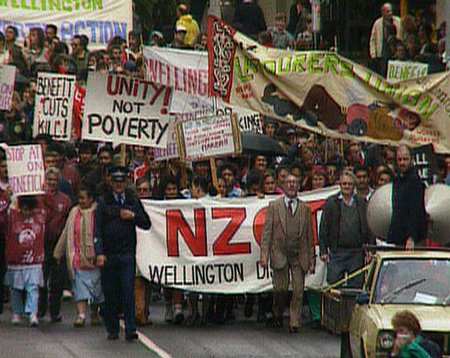
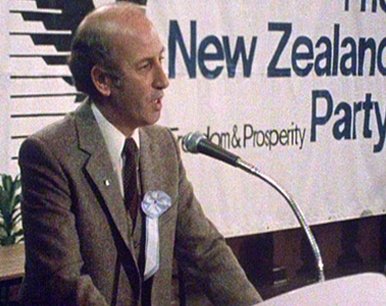
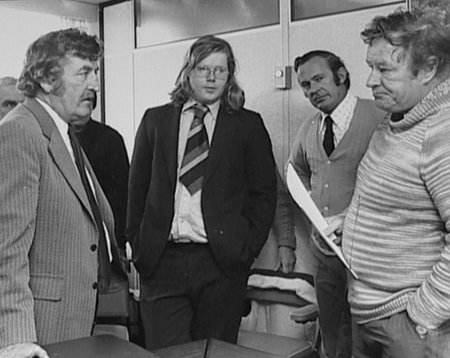
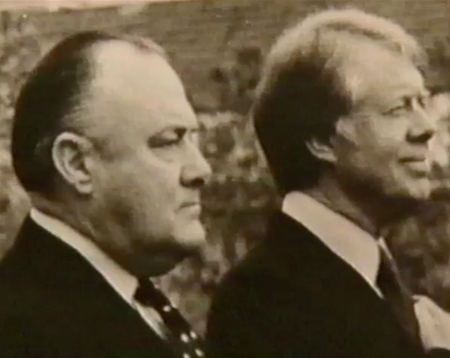
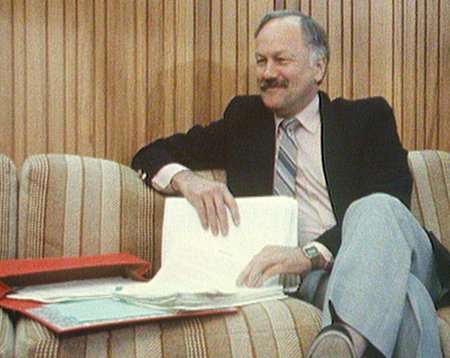
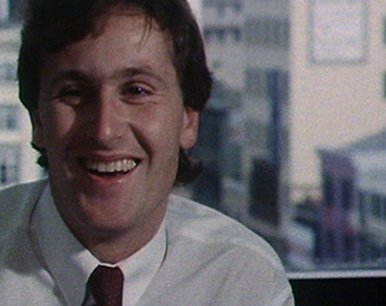
Someone Else’s Country looks critically at the radical economic changes implemented by the 1984 Labour Government - where privatisation of state assets was part of a wider agenda that sought to remake New Zealand as a model free market state. The trickle-down ‘Rogernomics’ rhetoric warned of no gain without pain, and here the theory is counterpointed by the social effects (redundant workers, Post Office closures). Made by Alister Barry in 1996 when the effects were raw, the film draws extensively on archive footage and interviews with key “witnesses to history”.

It is a quarter of a century since the New Right revolution began in New Zealand. New right ideology has become known as neoliberalism – a new version of an old idea of economic liberalism that says that society is best organised by free ...
It was no accident that Someone Else’s Country wasn’t screened on TVNZ when it was completed in 1996.
It wasn’t that the Business Roundtable needed to actually tell the TV programmers not to screen it. ...
Please keep your comments relevant to this title. Email addresses are never displayed, but they are required to confirm your comments.

And in 2012 here we go again. Key Government Mk1 refused to have Douglas in the Cabinet. Key Government Mk2 looks set to repeat Rogernomics ( as far as it can get away with it). We keep making the mistake of pointing the lens at the public spokespeople and forgetting to dig down to the puppet-masters, who must exist and who must straddle multiple elections and political structures. Did Don Brash wake up one morning and decide to roll his old mate Rodney? Where do the ideas come from? And are the NZ puppet-masters themselves merely puppets to some higher authority? That'd be the real story and it would be fascinating.

I'd like to think you're right that our values haven't changed, but actually I disagree: NZers may not consciously regard extremes of poverty and wealth as "normal and necessary", but in general they now ACCEPT them as "how it is"... and to a larger extent ignore the ramifications of the increasing rich/poor divide, and especially their part in contributing to it. in short, they're well on the way to a state of mind that does see this as "normal" - if not necessarily "necessary". Thank you Roger et al.
And the societal process of forgetting what changed and how it came about is part of the deliberate dumbing-down and disenfranchising of the ordinary citizen that is at the heart of the social engineering toolbox of the New Right: make people feel vaguely ashamed they were suckered into something they disagreed with and they will gladly ignore that it happened - that it is still happening.

It's like deja-vu - this is exactly what Australia went through under the Hawke/Keating government in the same time period.
What are the chances the same things happen to two completely different countries? It just goes to show you there are other people running things behind the scenes in probably most countries.
You need to be logged in to add to your favourites.
Television, 1987 (Full Length Episode)
A polar opposite perspective on the market
Television, 1987 (Full Length Episode)
The series to match the excesses of the era
Television, 1987 (Full Length Episode)
The first episode features a union dispute
Television, 1981 (Full Length Episode)
This series looks at office working life in the 80s
Television, 1990 (Full Length)
More political leadership machinations
Television, 1984 (Full Length Episode)
A documentary hosted by narrator Ian Johnstone
Andrew
Posted at 10.00PM - 08.04.2013
Serious Fun: The Life & Times of Alan Gibbs
Author: Paul Goldsmith
In this biography we are told how Alan made a $200 million dollar profit
from selling shares in Telecom (financed by a cheap Telecom loan) when he was a director. (There is a NZ Herald article on this).
I think this shows utter contempt for democracy and the tax payers of New Zealand.