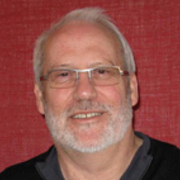
Dave Gibson
In late 2013 the NZ Film Commission announced Dave Gibson's appointment as its new Chief Executive. It was a key moment in the career of one of New Zealand's busiest producers. After more than three decades of diverse screen production, the man who founded the company sold his shares to a group of Gibson Group senior staffers.
Gibson's eclectic screen career began while playing around with cameras, as he studied to be a teacher. His education degree would be swiftly railroaded by a growing interest in making short films. While shooting a short film on Aorere College for the education department, he realised that his passion for filmmaking had outgrown his interest in teaching and “the idea of becoming a teacher just disappeared really”. A part-time job shifting TV sets got him further hooked.
By 1974, Wairarapa-raised Gibson had begun directing short films for the education department. Self-confessedly "not very good at working for other people", he rented an office in Wellington's Courtenay Place. "The timing was good". Though local screen opportunities were then limited, so were the number of companies he was competing with. Gibson mined a thriving international market for 'educational' films, many involving children living in far-flung locales.
Children's programmes helped make Gibson's reputation; including fantastical Margaret Mahy series Cuckoo Land and many one-off dramatic tales, of which Black Hearted Barney Blackfoot was one of the earliest. A frequent collaborator of Mahy, Gibson would often stay at her house while working on scripts. Reflecting on what makes a good creative collaboration, Gibson shared his theory that “you should never work with, anybody that you wouldn’t have in your house and actually have dinner with”.
Having launched as Gibson Film Productions, the company became Gibson Group in the 1980s. By the end of that decade, it had begun to expand into sketch comedy, starting with wildly ambitious series Public Eye, which began as a co-production with TVNZ. The show featured large scale puppets playing politicians and celebrities. Gibson soon discovered that local audiences preferred the show dial down the "savage satire" of its inspiration, England's Spitting Image. Over a decade later, Gibson Group sketch show Facelift tried a similar trick, this time with actors aided by prosthetic makeup.
At a time when TV executives seemed distrustful of allowing Kiwi comedians onscreen, Gibson went out and employed emerging comic talents — including Jemaine Clement and future bro'Towners Oscar Kightley and David Fane — to work on a run of sketch shows: among them Away Laughing, Skitz (which ran for four seasons), Telly Laughs and Newsflash. He also actively attended university revue shows across the country to scout fresh comedy talent. It was at one of these revues that he discovered the comedy group Facial DBX.
The expansion of genres continued in the 1990s. By 1991 Gibson Group had a five-year drama deal with TVNZ, and employed 80 people, with a permanent core of 12 staff. Gibson produced Mahy-scripted mini-series thriller Typhon's People; Cover Story, a drama set behind-the-scenes on a current affairs show; and Duggan, starring John Bach as a brooding Marlborough Sounds detective.
Gibson co-produced two series of children's drama Mirror, Mirror, which won awards on both sides of the Tasman. He has also been a prolific producer of magazine shows examining arts and culture, from The Edge (1993-94), to Sunday (1995-97), the multi award-winning Backch@t (1998 - 2000), and the Oliver Driver-hosted Frontseat (2004-2007).
By 2006 the company was nominated or the winner across NZ Screen Awards for drama, comedy and children's programming, and winning kudos for award-winning, genre-stretching series The Insiders Guide to Happiness and The Insiders Guide to Love.
For Gibson the medium makes little difference, so long as the project is an interesting one. Increasingly active in working with developing technologies, the company branched out to provide multi-media and interactive visitor attractions for museums, both here (including Our Space at Te Papa) and overseas.
Gibson Group also created cutting edge quiz programme The Simon Eliot Show, utilising new technologies which allowed an animated character to interact with live contestants, and New Zealand's first 'mobisode', MyStory. Conceived for mobile phones, MyStory 'screened' on both the web and youth music channel C4, spearheading debate and discussion about new media storytelling.
Gibson has produced three feature films. Big budget 1984 children's tale The Silent One — the beloved tale of a friendship between a boy and a turtle — was the first Kiwi feature directed solely by a woman (Gibson's then partner Yvonne Mackay). Glenn Standring's 2000 horror success The Irrefutable Truth about Demons was produced by Gibson under company offshoot First Sun; it was followed in 2012 by cannibal comedy Fresh Meat (directed by Danny Mulheron). "Films take an incredible amount of time," Gibson said in a 2010 interview. "TV is quicker and keeps you fresher".
Gibson's other productions include two ambitious natural disaster dramas for television: Graeme Tetley-scripted Qantas award-winner Aftershock (2008) was backed by a what would you do documentary, and a website about earthquakes. "Some people who tuned in late thought it was a breaking news story," says Gibson. The Auckland-set Eruption followed in 2010.
In this extended ScreenTalk Legends interview, Gibson reflects on the Gibson Group’s company philosophy to “climb more interesting mountains”. He explains that with a wealth of projects to choose from, they embraced a mindset of always seeking new challenges. "The idea was always that there was another more interesting mountain to climb; if we'd done it before, we were less inclined to want to do it again. We wanted to move forward and do other interesting things."
Long happy to play his part in lobbying and industry politics, Gibson was the inaugural Chair of the New Zealand Independent Producers and Directors Guild, and chaired the first NZ Film and Television Conference in 1992. He also chaired Kiwi screen initiative Project Blue Sky, taking the Australian Government to court, fighting for and winning equal access for New Zealand television content in Australia. In 1997/1998 he served as president of producer and director organisation SPADA. In 2005, he was awarded the honour of SPADA Industry Champion, and in the 2012 Queen's Birthday Honours list, the Order of New Zealand Merit.
His term at the helm of the NZ Film Commission kicked off in January 2014. In June 2017 Gibson announced he would be leaving the job at the start of 2018, arguing that "CEO's shouldn't stay too long in organisations like the NZFC". During his time as Chief Executive, the commission closed its sales agency, claimed an increased amount of Māori and Pacific content, and introduced an on-demand service for New Zealand films. Looking back on the range of films made during his time as CEO, Gibson said "With some of them, you know in your heart that that film might not have got made if I wasn't there. That's a nice feeling."
Profile updated on 7 August 2024
Sources include
'ScreenTalk Legends - Dave Gibson' (Video Interview) NZ On Screen website. Director Kathryn Quirk. Loaded 15 August 2024. Accessed 15 August 2024
'Interview with Dave Gibson' (Video Interview) NZ On Screen website. Director Clare O'Leary. Loaded 8 October 2008. Accessed 2 December 2013
Gibson Group website
Annie Simon, 'The Simon Eliot Show' NZ On Screen website. Loaded 16 August 2008. Accessed 2 December 2013
Rachel Lang, 'Gibson Goes Public' (Interview) - Onfilm, June 1988, page 26 (Volume 5, No 4)
Patrick McLennan, 'Gibson Group plans expansion' - The Evening Post, 11 May 1991
Joseph Romanos, 'Dave Gibson: Saying it on film' (Interview) - The Wellingtonian, 13 May 2010
Unknown writer, 'NZFC Appoints Dave Gibson as New Chief Executive' (Press release) NZ Film Commission website. Loaded 3 December 2013. Accessed 3 December 2013
Unknown writer, 'New Zealand Film Commission CEO To Step Down' (Press release) NZ Film Commission website. Loaded 20 June 2017. Accessed 21 July 2017