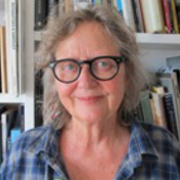
Dorthe Scheffmann
Dorthe Scheffmann grew up in Taranaki and Waikato, after her family migrated from Denmark when she was a child. Her father was a veterinary surgeon. As an immigrant, she recalls observing Kiwi life through the eyes of an outsider: "I watched my way to adulthood".
Scheffmann's film career began with Sleeping Dogs (1977), the film that helped launch the late 70s New Zealand film renaissance. Over the next decade, she worked on a series of seminal Kiwi films, doing everything from continuity and props to assistant directing and production management and supervision.
Working in continuity on classic road movie Goodbye Pork Pie, Scheffmann fell in love with the country, "and came to understand something of what being a New Zealander is all about. It was the moving through New Zealand at the rate we did — from top to bottom and back again, and everyday watching great actors do what they do, from Kelly Johnson to Marshall Napier's West Coast traffic cop to John Bach's junkie".
In the late 70s Scheffmann and her then partner, cinematographer Stuart Dryburgh, founded company Streetlight Productions, which rented out lighting equipment. She was a production manager on historical drama Pictures (1979), followed by Smash Palace and Carry Me Back, and later production supervised three features with producer Larry Parr — Constance, Pallet on the Floor and Came a Hot Friday. In 1985 she gave birth to her first son, Tomas Dryburgh.
In 1987, the year her daughter Isobel Dryburgh was born, Scheffmann formed company This is it Limited with director Gregor Nicholas. She managed the company for the next nine years, producing a line of award-winning commercials, and the acclaimed Nicholas-directed short Avondale Dogs. She was also involved in the long development of movie The End of the Golden Weather, pitching the project at the 1990 Cannes Film Festival, before stepping back following the birth of her third child, Emil Dryburgh.
In 1992 Scheffmann and Dryburgh launched iconic Ponsonby restaurant and bar SPQR to generate income for their filmmaking ventures. Profits from SPQR funded Sceffmann's first short films as a director: The Beach and The Bar. The Beach is an intimate story of two women (Donogh Rees and Elizabeth Hawthorne) at a turning point in their friendship. It screened in competition at Cannes and won a prize at the Hamburg Short Film Festival. Meanwhile The Bar is an ensemble tale, which tested Scheffmann’s view that a film should be paced as much by character development as narrative.
After completing post-production of The Bar in Denmark, she returned to New Zealand to direct her third short, returning home tale A Funeral. Alongside partners Riwia Brown and Kara Paewai, she shepherded six shorts through development for the NZ Film Commission, including award-winners Still Life and Cow.
Between 1999 and 2004 Scheffmann directed TV commercials and line-produced Stewart Main's feature 50 Ways of Saying Fabulous.
Scheffmann has long maintained an interest in women's cinema. This passion shaped her Master of Philosophy thesis A Feminine Language in Cinema, which was written as a manifesto on making films for female audiences.
In 2017 she began filming her first feature as writer, director and producer. Released in November 2018, Scheffmann calls the film "a meditation on life, death and the strength of family and friends in a summer of crisis, which celebrates love and generosity in a richly female-centred household". The film stars a group of "mothers, daughters, friends and neighbours", including Jennifer Ward-Lealand, Goretti Chadwick, Teresa Healey and Emily Campbell.
Ward-Lealand plays a musician whose daughter is set to marry. Behind the scenes, the production team were 85 per cent female. Seeking a better way to work, Scheffmann avoided the common system of shooting a movie in one concentrated burst. Instead, Vermilion was filmed in five blocks, with a week for rehearsals and editing between each block of filming.
Since 2004, Scheffmann has worked at Auckland University in the Department of Film and Media Studies as a Master's Supervisor and at Unitec's Performing Arts School, where she headed the Screen Programme. Her teaching is informed by her own research and practice, culminating in her PhD at AUT in 2025, which examined Vermilion as a "feature film in the feminine." She has supervised many Master's film projects, where she applies her deep commitment to mentoring the next generation of filmmakers and the representation of women on screen.
Updated on 14 October 2025
Sources include
Dorthe Scheffmann
Richard Raskin, ‘The Beach: An interview with Dorthe Scheffmann’ - p.o.v issue 3, March 1997
Unknown writer, 'Jennifer Ward-Lealand leads ensemble cast in feature film' (Press release) NZ Film Commission website. Loaded 20 February 2017. Accessed 31 October 2018
Vermilion press kit