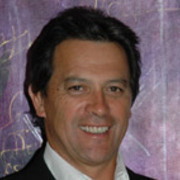
Ian Taylor
Ian Taylor was first seen on Kiwi TV screens as a co-host on children's shows Play School and Spot On. Now, thanks to the work of his company Animation Research Limited, Dunedin has become a world centre in computer graphics technology for sports coverage. Taylor has described himself "an accidental businessman". After hitting 40 he decided it was time to "do something" and he quickly found himself employing 20 people.
Born in the Northland town of Kaeo, Taylor grew up in the East Coast town of Raupunga near Napier, where he remembers reading Eagle comics by the light of a gas lantern. The arrival of electricity in the house provided the young boy with a genuine light bulb moment: "At eight years of age I figured if you could do that by flicking a switch, you could do anything."
At age 18, Taylor began singing with band Kal-Q-Lated Risk, before he was called up for Aotearoa's last intake of compulsory military training. After a year as a forklift driver at Speight's brewery in Dunedin a law degree got sidelined when he was invited to co-present TV's Play School. After graduating, Taylor turned down a law job to join the Dunedin team of children's magazine show Spot On. In the late 1970s he began directing and producing, including rowing documentary Pieces of Eight, episodes of Journeys across Latitude South, and 1983 caving chronicle Two Days to Soft Rock Cafe. The later won multiple Feltex Awards, including Best Director and Best Documentary.
At the age of 40, thanks to a generous loan (he had only $1000 in the bank) Taylor went solo. TVNZ had offered him a current affairs job in Wellington; they'd also just closed down their Dunedin operation. Says Taylor: "I'd already made that decision I wasn't leaving Dunedin so the only option was to buy the place." In 1989 he founded production house Taylormade Media, and on-line booking company BookIt in the old brick TVNZ building in Dunedin. Graphics company Animation Research Limited officially followed in 1990. It began as a joint venture with Otago University, before Taylor bought it out. "I went from a staff of none to 20 overnight".
Taylor started by making commercials and corporate videos, and the first of many children's programmes. But yachting provided the big break. Otago University computer science professor Geoff Wyvill had told him that 3D animation "would be the thing of the future", and introduced him to some of his top students. Taylor "barely knew what a computer was"; in 1991, he was one of four — alongside Wyvill, Paul Sharp, and Stu Smith — to develop the first ever real-time yachting graphics package. Commissioned originally by TVNZ, and first showcased at the 1992 America's Cup in San Diego, the programme allowed races to be tracked and displayed on screen in real time, with graphics demonstrating the nuances of the race.
Animation Research Limited has gone to to apply the Virtual Eye system to coverage of golf, cricket, and car racing, allowing viewers to follow the paths of a variety of moving objects. In 2006 alone, graphics developed by ARL were used in 30+ golf tournaments, including the US Open and the Ryder Cup.
In July 2008 ARL trialled a new ball-tracking system, at a cricket match in Sri Lanka. The system allows players to challenge umpire's decisions to another umpire, who uses the technology to help make a judging call. The ball-tracking project almost led to the company's demise, after a contract in India collapsed unexpectedly, leaving ARL "about $2 million in debt". Taylor almost closed down the business, but it later recovered.
Outside of sports, ARL has contributed computer animation to a range of television shows: among them Kiwi documentary series Human Potential, the BBC's Inventions that Changed the World, and the catalogue of CGI calamities showcased on National Geographic series Mega Disasters.
Jamie Belich's The New Zealand Wars included a half hour of ARL computer animation, recreating Māori Pas and European settlements circa the 1800s. The company has also re-imagined an encounter between a sperm whale and a giant squid (for NHNZ show Animal Face-Off) and in 1996 pioneered the use of motion capture on local television, with Squirt. Co-hosted by a 3D penguin, the show ran for ten seasons. Motion capture was also used to create the virtual dancer Jenna, for long-running live show Studio2.
On the dramatic front, ARL supplied CGI for award-winning Margaret Mahy series Kaitangata Twitch and the part-animated Moko Toa. The Māori language children's drama combined live action with CGI landscapes and characters, to tell a tale of a Māori boy who is the modern transformation of ancient hero Moko Toa. The company were also called upon to create the climactic scenes in 2010 tele-feature Eruption: a volcano emerging from Auckland harbour.
Animation Research won acclaim and awards early on, including a triumphant screening at a SIGGRAPH computer graphics convention, of commercials for Air New Zealand (featuring flying gannets) and Bluebird chips (a skiing penguin). The company has also created multi award-winning air traffic control simulators and worked in building and tourism, including a virtual tour for company Whalewatch Kaikoura. Taylor also helped Dunedin director Robert Sarkies bring his breakthrough short film Signing Off to the screen.
In 2013 Animation Research developed an app for the America's Cup which allowed fans to watch and comment on races, through their cellphone. Taylor said the app — which won a Sports Emmy — demonstrated "you don't have to up stakes and move to the big centres to create international products". Aside from ARL's own staff, the app's creation involved "a technology company from Queenstown, a design company here in Dunedin, and a two man operation out of Timaru".
In 2010 North and South magazine named Taylor their New Zealander of the Year. In 2012's New Years Honours saw him named a Companion of the NZ Order of Merit, for services to television and business. In 2021, after becoming a Knights Companion, he paid tribute to those who worked with him. "I’ve always been a storyteller, but the people I work with, they wrote the story.". Taylor told The Otago Daily Times that his success owed much to staying in Dunedin, and surrounding himself with talented people.
Taylor has also investigated ways that technology can benefit healthcare, education, and inspire Māori to work in the tech sector — including a virtual reality programme to help children get over their fear of MRI scans, and one that helps improve prisoners' numeracy and literacy skills.
Through Taylormade, he has produced documentaries Blokes'n'Sheds (based on the bestselling book by Jim Hopkins) and Britten: Backyard Visionary.
Profile updated on 12 January 2021
Sources include
Animation Research Ltd website. Accessed 12 January 2021
Amber Allott, 'This is an honour for all of us' - 30 years of teamwork behind knighthood for presenter turned tech guru Ian Taylor' Stuff website. Loaded 31 December 2020. Accessed 12 January 2021
Eileen Goodwin, 'Taylor credits staff, partners, wife for success' (Interview) - O
The Otago Daily Times, 31 December 2011
Alan Wood, 'Dunedin turned rock'n'roller into TV entrepreneur' (Interview) - Stuff website. Loaded 31 December 2011. Accessed 12 January 2021
'Ian Taylor - Creative Innovator' (Interview) NZ Hi-Tech Awards website. Accessed 9 January 2012
'America's Cup: Ian Taylor recognised for VirtualEye development'. Sail-World.com website. Loaded 31 December 2011. Accessed 12 January 2021
'America's Cup Goes Mobile with Kiwi App' Animation Research website. Loaded 17 September 2013. Accessed 12 January 2021
ADD RNZ ARTICLE,CHECK HERALD ARTICLE
The great thing about travelling the world is that you get to really appreciate what we have back here. We are a country that has always punched above its weight.
check year for sports emmy
10.17 - 30
https://www.nzherald.co.nz/business/new-year-honours-sir-ian-taylor/UQTR66UCUMLBPZLEVIHQ5CI2BQ/