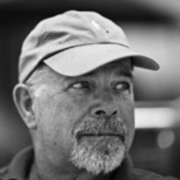
Peter Sharp
Christchurch-raised Peter Sharp originally dreamed of being a doctor. But after a year studying at Canterbury University, he was among the bottom 10 per cent who didn't get accepted. An alternative needed to be found. "I was thinking that perhaps, with all my piano lessons, a career in classical radio might be possible."
Nothing was immediately available in radio, but by the end of 1961 Sharp was offered a job at new television station CHTV-3. The station had begun transmitting from Christchurch the same year.
Sharp began by writing continuity links and compiling transmission logs, but soon found himself learning about television in many ways. "In those days, you were called upon to try a hand in almost every department. The programmes never ran to time — if we had three or four minutes to fill, you'd point the camera at the fish tank and play some music. One time, the fish went to air, but seemed to have learnt to congregate off camera at one end of the tank when the lights were on. 'Peter,' said the presentation officer, 'go and tap on the end of the tank and send them back.' I did, and they immediately swam straight off camera at the other end. 'Peter, go and tap on the other end and send them back.' And I did, in front of the camera. The first, and possibly best piece of production advice I learnt, and never repeated, after the earful I got from the control room: Never cross a live camera."
Sharp had done some acting as a child. After he presented some humorous items for local magazine show Montage, the powers that be told Sharp's boss David Pumphrey not to use him on-screen again, because his voice wasn't up to scratch. Pumphrey ignored them.
Thanks to Pumphrey and fellow Christchurch producer Stan Hosgood, Sharp got the chance to do state television's Producers and Directors Training Course in 1970. His "illustrious" company included Wayne Tourell, John Whitwell, Murray Reece and David McPhail. His first productions were an eclectic mix, including ballroom dancing (Let's Dance), science (In the Nature of Things, presented by Ron Walton), and regional news (The South Tonight, featuring Rodney Bryant and Bryan Allpress).
Many of his favourite projects connected to his love of classical music: three studio performances by the Royal NZ Ballet (comic ballet Pineapple Poll, Uirapuru, and Pania of the Reef), live concerts by the NZ Symphony Orchestra (including a 1972 prom conducted by Englishman Stanley Black), and a performance by the Bath Festival Orchestra, featuring siblings Yehudi and Hephzibah Menuhin.
"Orchestral concerts provided huge excitement. Once the music started, there was no turning back: the outside broadcast van vibrating to the the rhythm of huge works, as the score reader counted out the bars, the production secretary called the shots, and I'd try to cope with the sports cameraman not fully knowing the difference between a cor anglias and the timpani."
In 1975 the NZ Broadcasting Corporation was reincarnated as Television One and Television Two. The new second channel quickly morphed into South Pacific Television. When Sharp was asked to direct an episode of short-lived soap A Going Concern, he suddenly realised how much more fun hands-on directing was than producing. When John McRae returned from England to take over the drama department, Sharp was invited to join full-time.
Until the late 80s, when the channel's names changed again, Sharp worked on most of the big dramas of the time — including Radio Waves, Both Sides of the Fence, Country GP, and Gloss. Acclaimed police drama Mortimer's Patch led to Sharp's only stab at directing a feature (though a number of his TV projects have been combined into TV films). Trespasses starred Patrick McGoohan (The Prisoner) and Frank Whitten (Vigil).
Sharp has written fondly for NZ On Screen about four of the kids dramas he worked on. He got valuable on the job training with Childs Play, an eclectic anthology show based on stories by school children, then graduated to multi award-winner Children of Fire Mountain (1979), a period piece set featuring Mount Tarawera. "It was entirely shot on location — largely around Bethells Beach near Auckland." Sharp reminisces here about the show's impressive young leads, mysterious waka and uncooperative animals.
Maurice Gee tale The Fire-Raiser reunited Sharp with the Royal NZ ballet star Jon Trimmer, who gave "a heartfelt performance" as tortured firestarter Edgar Marwick. The character had very little dialogue, which was "perhaps just as well, as we managed to break Jon’s jaw during a fight scene with Peter Hayden in the first week of filming." Trimmer did most of the role with his jaw wired shut.
The Fire-Raiser marked the first of a number of collaborations with producer Ginette McDonald. During an on-set interview with Onfilm, McDonald called Sharp "the master of the kidult drama — he's not embarrassed by it. He fully embraces the concept of well-made, superior family drama."
Fire-Raiser's story of an arsonist running amok sold well internationally, and won awards in Australia and the United States. Locally it walked away with GOFTA awards for director, Best Drama, Best Children's Programme and Best Script.
In 1988 Sharp began working on Maurice Gee's The Champion, which turned out to be the last drama made before TVNZ closed down its in-house drama department. Sharp called it "the best work I ever did". It told the story of a young American GI billeted with an eccentric Kiwi family during WWll. Sharp argues that the show "slipped into obscurity through bad scheduling, no publicity, and the lack of awards that year". Sharp writes here about filming amidst mud and mangroves, and failing to cast Cuba Gooding Jnr.
In between the two Maurice Gee adaptations, Sharp directed possibly his most ambitious production. Erebus: The Aftermath focused on the Royal Commission of Inquiry into the Erebus disaster. Sharp recalls that Greg McGee's script was "scrupulously vetted by lawyers, and deviations from the printed word were not acceptable." Some scenes needed to be reshot. "The problem was not only the actual words but also the delivery. Had a particular reading changed the implication?"
With speaking parts for 600 actors, the four episodes played on consecutive nights to glowing reviews, and high ratings. Erebus won LIFTA awards for Best Drama, Sharp's directing, and Greg McGee's script. Sharp followed Erebus with six-part Margaret Mahy tale Strangers, which featured teen actors Joel Tobeck and Martin Henderson — the latter making his screen debut.
In the 90s Sharp worked extensively as a freelance director. The dramas included Street Legal, 10 episodes of Marlin Bay, and six of City Life; the family fare balanced local productions (horse story Star Runner) with shows produced for an international audience (The Enid Blyton Adventure Series, Shelley Duval's Mrs Piggle Wiggle, a TV retooling of The Black Stallion).
Looking back, Sharp notes a growing professionalism on both sides of the camera over the decades. "Working with international stars was like taking a university course". He notes the talents of British actors George Baker (star of Ngaio Marsh Theatre) and Frank Finlay (Justice Peter Mahon in the Erebus miniseries). He also recalls working with Phyllis Diller (who jumped from "quiet and sweet" to memorably dizzy, when the cameras rolled) and veteran Mickey Rooney (who spent as little time on set as possible).
In 1993 Sharp reteamed with producer Ginette McDonald for a telemovie adaptation of Robert Lord's classic play Joyful and Triumphant, plus another show which saw McDonald back in front of the cameras: Fiona Samuel's Her New Life (one of two monologues directed by Sharp under the Face Value banner).
Sharp started doing work stints in Australia in the 80s, initially with Grundy Productions. His first Aussie outing was Prisoner, followed by another Australian perennial, Sons and Daughters. He also directed episodes of All Saints, including the pilot, more than 20 episodes of police show Blue Heelers (including the final episode), and Neighbours.
Sharp can also occasionally be spotted on-screen: he cameos as Father Christmas in Gaylene Preston comedy Ruby and Rata, and appeared in one of Country Calendar's infamous spoofs as an ex-Queen Street hairdresser who has turned to sheep farming.
Profile written by Ian Pryor; updated on 28 October 2025
Sources include
Peter Sharp
Peter Sharp, 'Fighting the Tides - Directing The Champion' NZ On Screen website. Loaded 30 June 2023. Accessed 12 October 2025
Peter Sharp, 'Filming the Fire-Raiser - Broken Bones and Swimming Holes' NZ On Screen website. Loaded 18 April 2024. Accessed 12 October 2025
Peter Sharp, 'Start 'Em Young' NZ On Screen website. Loaded 25 September 2025. Accessed 12 October 2025
Peter Sharp, 'Catching the Fire' NZ On Screen website. Loaded 26 September 2025. Accessed 12 October 2025
Shelley Clement, 'Last of the In-House Heroes' - Onfilm, June 1989, Page 33 (Voume 6, No 4)
Robert Boyd-Bell, New Zealand Television - The First 25 Years (Auckland: Reed Methuen Publishers, 1985)