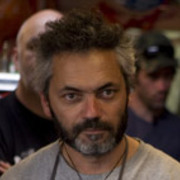
Rewa Harre
As a teenager in the early 1980s, Rewa Harre jumpstarted his filmmaking career when he turned his family home into a haunted house. The family's big old property in Oratia on the Western edge of Auckland made for a perfect location for a short film, "surrounded by orchards and fruit sheds". Harre's film The Ghost of Albion Vale won the annual filmmaking competition on beloved youth show Spot On. With the first of many awards under his belt, Harre left school knowing what he wanted to do: "work in the film industry, and train myself up as a cameraman".
Within three months, Harre had won a scholarship from cinema chain Kerridge Odeon to work in the camera department of 1940s-set feature Constance. "Camera Assistant sounds way too fancy for my position then," says Rewa of his credit, though he recognises that Constance was a great first film to work on. "It was a real arthouse film,” with cinematographer Kevin Hayward pulling off "some amazing and ambitious shots".
Constance feels especially appropriate as a first film for Harre; he fondly remembers his father bringing home foreign and arthouse films from the Auckland University library. "He’d invite friends around in the evening and we’d have outdoor night-time film screenings of Ingmar Bergman, Russian films — all sorts from around the world." As a result, Harre grew up "looking out rather than in", with an interest in ideas, cultures, and insights from overseas.
When he learnt that Roger Donaldson was directing The Bounty in Tahiti, Harre decided to use money earned from Constance to fly over and see if he could be part of the camera crew — only for him to end up as an onscreen extra. But the experience of being on-set proved valuable, and after returning to Auckland, he kept an eye out for any productions getting shot nearby, so that he could "drive out and be a pain, and turn up just to watch". Odd jobs on sets like lighting assistant, gaffer, or wardrobe became Harre’s filmmaking education, after an application to a film school in Paris was disrupted following the 1985 Rainbow Warrior bombing.
Swapping his wind-up Bolex for a professional 16mm camera, Harre was able to offer himself and his gear as a package deal. In this period, he "shot a lot of short films and a number of music videos". Among them was operating the camera on the first short film by Greek-born filmmaker Athina Tsoulis, A Bitter Song (1990). Tsoulis was "a pretty new and inexperienced filmmaker with an outsider’s voice". Harre quickly got on well with her, admiring the "un-New Zealand" way she wanted to tell stories.
Harre and Tsoulis collaborated again for Revelations (1992), a half-hour TV drama about a Greek immigrant family, and I’ll Make You Happy (1998), the first feature for both of them (though Harre had been the second unit cameraman on Jane Campion feature The Piano) . A decade later, Harre and Tsoulis worked on returning home drama Jinx Sister. It was nominated for three 2008 Qantas Film and TV Awards, including best low-budget feature. Later came Stars in Her Eyes (2016), a romantic comedy set in Auckland’s Indian community.
Alongside his long collaboration with Athina Tsoulis, Rewa Harre shot O Tamaiti, the first short film by Samoan-born director Sima Urale. It won awards at festivals in Venice, Korea, Chicago and Aotearoa (read more about it here), and remains one of Harre's favourite projects. He collaborated with Urale for two more award-winning shorts, Still Life and Coffee & Allah, plus documentary Hip Hop New Zealand and Urale’s first and to date only feature, Apron Strings. Also touching on the Indian community of Tāmaki Makaurau, it won four awards at the 2009 Qantas Film and Television Awards, including a Best Cinematography gong for Harre.
Harre argues that Urale and Tsoulis both offer "a different perspective", and he appreciates "the stories they want to tell, and how they want to tell them". The visual element is a key factor: without a director who knows how to tell a story visually, "you’re in the middle of a big, wide-open ocean". Harre also namechecks another key collaborator: director Andrew Bancroft (who Harre worked with on short film Home Kill, multi award-winner Ngā Tohu: Signatures and arts shows Mercury Lane and The Book Show).
Although Harre has a continuing fascination with other cultures, he remains committed to New Zealand, and has worked on numerous significant Māori productions. Alongside contributing camerawork to Merata Mita documentaries Dread and Saving Grace - Te Whakarauora Tangata, he was cinematographer on feature drama The Pā Boys and short film Warbrick, which both won awards at the Wairoa Māori Film Festival. Harre lives "in constant hope that I can be involved in good stories with indigenous Māori behind them — that’s what makes New Zealand unique."
This commitment to Māori stories is expressed through the groundbreaking television productions that Harre has shot across his career. He has credits on primetime Māori anthology show E Tipu e Rea, Polynesian documentary series Tagata Tangata, award-winner NZ Wars - Stories of Waitara and an episode of international indigenous series From Spirit to Spirit. On the drama front, he was cinematographer on 1994 teleplay Kahu & Maia (one of his earliest dramatic credits), and episodes of both Taonga and Mataku (for which Harre won Best Camera: Non-Factual at the 2005 Qantas TV Awards).
Rewa Harre’s screen contributions are varied, from Geoff Murphy's final dramatic feature Spooked, to Jonah Lomu miniseries Jonah, to his award-winning work on documentary series Why Am I? The Science of Us. Since the turn of the millennium, he has been cinematographer for many leading local crime shows — including the long-running Brokenwood Mysteries, award-winners One Lane Bridge and The Gulf, and Lucy Lawless dramedy My Life is Murder. "My hero cinematographer was always Vittorio Storaro", states Harre, referencing the Italian's use of colour and approach to capturing a setting, qualities immediately present in these drama series.
In 1987, Harre shot The Second Blade of Grass - Rewi Alley’s Life in China. It was directed by Rewa's father David, and Geoff Chapple. A decade later, David Harre appeared in front of Rewa’s camera as one of the three drunks in short film Lament for Barney Flanagan.
Alongside the many foreign films David introduced his children to as a child, David was also directly involved in filmmaking: he worked in educational television, and operated a small production company. Often Rewa and his siblings were told to "put together a story", so that when their father brought home his gear, they could all film it. Rewa credits him with for his own broad interest in film. "Because of the experience I had with my father, I was able to pick up a camera through him and just go shoot stuff. Pretty much all of my siblings are involved in filmmaking now. We all eventually got there in the end."
Profile written by Danny Bultitude; published on 23 September 2025
Sources include
Rewa Harre
'Rewa Harre' Internet Movie Database website. Accessed 23 September 2025