00:00
/
00:00
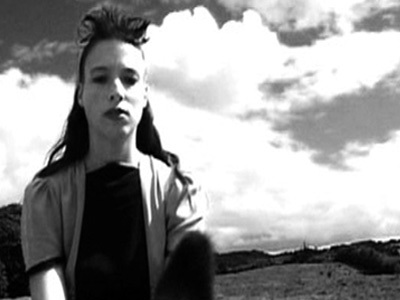
Woodenhead
Film (Trailer, Excerpts, and Extras) – 2003
A Perspective
Director Florian Habicht has a dream he loves to tell. He was at Carlaw Park in Auckland when two dreadlocked Rastafarian angels, dressed as pop group Milli Vanilli, appeared before him. After confessing that they didn't actually sing all their songs, they told him they had a message. For his next film, they wanted him to pre-record all the voices, all the location sounds and all the music. That film was Woodenhead.
While it would have been hard to resist such a disarming directive, Habicht realised there were some definite advantages in making a low-budget film in this way. It enabled him to focus separately on the visual and aural components of the film, allowing him, for example, to cast people who had the look he wanted but who weren't necessarily trained actors. With a limited amount of money to spend (around $30,000), Habicht also realised that he could achieve much higher quality results by taking care of the sound in a recording studio, rather than on location. He didn't need to take a sound recordist with him on the shoot, and normal concerns like traffic noise were a non-issue.
Furthermore, this style of filmmaking suited the filmmaker's intuitive style perfectly, giving the film a surreal, otherworldly feel. As well as being out of literally out of synch, he also accentuated the oddness by mismatching the soundtrack with what you see: often you'll find sweet and innocent dialogue accompanying grotesque and sometimes violent visuals, or a South Island kea screeching on a North Auckland road. He also enjoyed giving the actors voices that were incongruous with the way they looked.
Casting the two leads was easy — Teresa Peters was his girlfriend at the time (he said he had a habit of casting girls in his films he was keen on, as a way of wooing them), while the male lead role was always intended to go to his close friend Nicholas Butler. Like many of the people working on this production, and Habicht himself, the two had an art school, rather than a film or theatre background.
Some of the cast did have acting experience. The most experienced of these was Matthew Sunderland, who went on to give a searing performance as David Gray in Out of the Blue (2006). Also featuring is Warwick Broadhead, whose phantasmagorical theatrical creations entranced live audiences for years (Broadhead and Habicht would later collaborate on Rubbings from a Live Man, a film inspired by Broadhead's life). It's no surprise that he fits right into Habicht's world of magic realism.
Habicht had always imagined the film being in colour, though director of photography Chris Pryor was adamant that it should be in black and white — even offering to reduce his fee, as a sweetener. Habicht wasn't convinced, however once they saw the first cut, it was obvious that it was going to work much better in monochrome. It's now hard to imagine it in any other way.
Habicht was born in Germany and came to New Zealand as a young boy. His film has a distinctly Northern European feel to it, but it's this combined with a strong Kiwi quality that makes it unique; the Brothers Grimm on a Kiwi road trip. Musician and film reviewer Chris Knox describes the union of cultures as a "sexual coming together of a European penis and Aotearoan vulva".
Woodenhead was shot in Northland, and Pryor's wonderful cinematography makes the most of the striking, often foreboding, landscapes. Marc Chesterman, who went on to compose for many more Habicht films, wrote the music. This plays as strong a role in the drama as the visuals, conveying a brooding atmosphere through haunting songs and forlorn carnival bands, with much in between. Auckland- based musicians Steve Abel and Mardi Potter, who provide the voices of Gert and Plum, supply vocals on some of Chesterman's songs, as well as performing some of their own.
As well as screening to packed houses in Auckland at the 2003 New Zealand International Film Festival, Woodenhead also played at the Melbourne Film Festival. It was released theatrically, both in Auckland, after its festival screenings, and in New York in 2006.
Overseas reviewers were intrigued, but they didn't always last the distance. The New York Times talks about the film's "tilt-a-whirl" (ie disorienting) effect, saying that Habicht is "not entirely successful, but the effort is awfully interesting".
But local critics responded favourably to Habicht's imaginings, in a cinematic landscape where precious few arthouse offerings had been as distinctive or likable. Rip It Up magazine called it "undoubtedly one of the most disturbing, imaginative and artistically tight films to come out of New Zealand in the last few years", while the Otago Daily Times called it "the kind of movie you want to see at least twice".

If you liked this, you might also like...
The Florian Habicht Collection
From demolition derby drivers to spookmakers and...
Best Thing
Florian Habicht also worked with Steve Abel on this
Duet (Lonely I Be)
Also directed by Florian Habicht & shot by Christopher Pryor
Tales of Mystery and Imagination
Another film where images were made to fit the sound
Angel Mine
Another experimental first feature
Liebesträume
An early short film by Florian Habicht
The Dump
Another take on northern tip life
Circus Kids
More surreal black and white hijinks
Rubbings from a Live Man
More flights of fantasy from Florian Habicht
A Fairly Good Tale
Another Kiwi fairytale
The Price of Milk
A surreal film by Harry Sinclair
Christmas
Another offbeat feature shot in the far north
Dustie
A documentary on rubbish collectors
Kaikohe Demolition
The next film directed by Florian Habicht
James & Isey
Florian Habicht also made this film about a mother and son
Love Story
More from Florian Habicht
Pulp: A Film about Life, Death & Supermarkets
Florian Habicht's tribute to Britpop band Pulp
Charlie Horse
The story of a horse, rather than a donkey
The Promise - Sir Tristram's Story
Donkey ... horse ... get it?
Happity
Another unusual love story
Mrs Mokemoke
A black and white short film
We Feel Fine
Florian Habicht on the other side of the camera
Talk Talk - Series One
Florian Habicht talks about the movie (in episode nine)