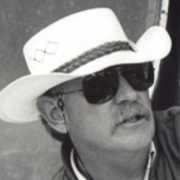
Wayne Tourell
Wayne Tourell’s career defies easy categorisation. Glance through the awards accumulated from all the varied shows he has directed, and you'll find everything from documentaries to comedies, to classic legal drama Hanlon— which he spent over a decade trying to get on-screen. In the early 1980s, after a long period dominated by documentary and current affairs, Tourell concentrated increasingly on helming drama.
The quantity of drama work on Tourell's CV likely owes something to his beginnings. The man that Bruce Allpress once described as "an actor's director" set his sights on becoming an actor early on, and it was William Shakespeare that first got him into a TV studio.
Born in Mosgiel, Tourell spent his early days in Wangaloa, near the mouth of the Clutha River. After boarding school in Dunedin, he did time as a cheesemaker. While doing night shifts looking after the boilers at Lincoln University (then Lincoln College), he got the chance to train in acting at Canterbury Repertory Theatre.
Amateur theatres were attracting full houses in Christchurch, and Canterbury Repertory was "the biggest in town". The company planned to go professional; in 1963 Tourell was one of 12 young actors picked for training by director John Kim. Tourell clearly did okay; that same year, he was chosen to star in hit comedy The Amorous Prawn. Then the company took on Shakespeare’s The Taming of the Shrew, and many of the cast crammed into a TV studio roughly the size of a living room, to shoot a half-hour version for television. Tourell played the jealous Hortensio (see photos) in one of the earliest dramas made for local TV. Periodically the actors had to freeze in position, as Kim entered the frame and filled in viewers on vital plot info.
Tourell was in love. "I knew this was the medium that I wanted to work in." But initial attempts to join state television went nowhere — partly because he didn't have a degree. Not one to mope, Tourell got busy acting on radio and stage (plus the occasional screen role). While farming with his father, he was also writing and directing plays. His much performed tragicomedy The Reciprocating Triangle won a Shell Playwright's Award.
In late 1967 Tourell successfully auditioned to present Well I Never, a kids show launching in Dunedin. After a "fantastic" year in front of the cameras, Rod Cornelius, the producer who'd offered him his TV break, gave him another. "After an hour's training I was directing On Camera, a half-hour show that went out twice weekly." As was the norm in those days, the next few years offered fevered on-the-job training in producing and directing: the work ranged from live sports to music and Town and Around.
After a brief try at writing adverts, Tourell spent the first half of the 1970s directing for indie company Reynolds Television. Educational and charity campaigns were an in-house speciality. Tourell directed two anti drink-driving films which played in prime time slots, including Feltex nominee On the Day. One Listener reviewer was so taken in by the drama, he failed to notice it was part of a drink-driving campaign./// Films for charities and varied educational-style campaigns were an in-house speciality
Tourell was experimenting with a naturalistic, semi-improvised storytelling style. Hello Human Being (1970), which predates Paul Maunder’s better-known Gone Up North for a While, dramatised cases of young women who were pregnant or widowed. Actors and non-actors performed together, on location, and on the fly. Tourell took the approach further for Salvation Army reunion tale Missing (1975), which won a Feltex Award.
Tourell won a grant from the Queen Elizabeth ll Arts Council to study film and TV drama in North America, setting off with cameraman colleague Malcolm Ferguson. Visits to the Los Angeles sets of Happy Days and M*A*S*H* proved "brilliant, creative and rewarding". The 1970s also saw adventures in Tahiti. Originally set to direct a documentary about the salvage of Captain Cook’s anchor, Tourell found himself demoted to become right-hand man to legendary director David Lean (Lawrence of Arabia). Working under Lean proved both inspiring and debilitating, depending on prevailing moods and weather patterns. As Tourell says in this interview, Lean even relocated the anchor to shallower water, to enable better angles on its salvage.
Although Tourell's American trip coincided with a jump in Kiwi drama output, the drama departments at TV One and the new second channel remained "a closed shop". Not so the documentary department; so Tourell got busy. In 1980 Moriori won the Feltex Award for Best Documentary. Part historical primer, part personal journey, it followed two grandchildren of the last full-blooded Moriori on a trip to the Chatham Islands to rediscover their heritage. Made with producer Bill Saunders, Tourell's doco helped launch a revival of Moriori culture and overturn misconceptions, including that Moriori were a separate race from Polynesians. Tourell writes here about recreating a Moriori village, hair-raising boat trips, and locals both helpful and wary.
Another influential documentary followed, when Tourell travelled the nation with Professor Kenneth Cumberland directing five of the 10 episodes of Feltex winning epic Landmarks (including this episode).
Tourell then turned his sights from New Zealand landscapes to the inner lives of the country's people. Although earlier projects had mixed drama and documentary elements, the early 80s marked the point where he seriously devoted himself to directing drama. Sea Urchins, Steel Riders and The Shadow Trader (which he writes about here) all proved solid international sellers. Tourell also enjoyed the high fashion hijinks of Gloss, survived the sleep deprivation of commanding the Telethon '88 broadcast, and developed the three-camera set up for Open House. But the project that meant most was one he’d spent 14 years pitching to TV executives, before it finally got a sympathetic ear in TVNZ's Head of Drama Ross Jennings— and later his replacement John McRae, who declared the pilot episode the best script he'd read.
Hanlon covers 20 years and six cases in the life of Dunedin barrister Alf Hanlon. A rare post-Governor historical drama made on a big budget, the 28 week shoot involved 160 speaking parts. Tourell and writer Ken Catran ignited water cooler discussion with their feature-length pilot, which brought a sympathetic angle to infamous Southland 'baby farmer' Minnie Dean. American studio Paramount pushed Hanlon into profit before launch by buying international rights for US$800,000, after viewing a rough edit of this episode alone.
Accolades like "flawless", "a triumph", "moving" and "engrossing" peppered the reviews, and the series dominated the 1986 Gofta Awards ceremony. Having run off with every major award, it was also nominated for an International Emmy for Best Drama. A planned follow-up series did not eventuate.
For Tourell the 1980s had revolved around local stories. The following decade, reflecting wider trends in the industry, more co-productions entered the mix, and the range of accents on-set began to broaden.
In the late 80s Tourell was in at the birth of South Pacific Pictures: he helped produce three family shows — including a puppet spin on King Arthur, and soccer drama All For One, the first of a number of coproductions made with SPP and Canada's Atlantis Films. Back behind the camera, co-productions were often on his menu. Alien encounter tale Boy from Andromeda sold well overseas, while the 'Fortitude' episode of Kurt Vonnegut’s Monkey House won three US cable TV awards. Tourell was nominated again for Shelley Duvall's show Mrs. Piggle Wiggle. On the award-winning Ray Bradbury Theatre, he recreated Dublin downunder, and was one of the first directors to work with actor Erik Thomson.
The 1990s saw many firsts. Tourell was picked to direct the all-important debut episodes of everything from Maggie’s Garden Show and White Fang to teen hit The Tribe and urban drama City Life — a show he suspects had its edges blunted, to fit an earlier time slot. That decade he also did 13 episodes of Marlin Bay, and the first of 500+ instalments of Shortland Street. He also spent 23 joyful days shooting his only feature.
Bonjour Timothy (1995) stars Dean O’Gorman as a high schooler smitten by a French-Canadian exchange student. The movie won awards at the Berlin Film Festival and a children’s festival in Belfast, and Tourell has great memories of hundreds of kids "rolling on the floor with laughter" at Giffoni in Italy, one of the world's biggest children’s festivals. Tourell’s work with a largely teen cast was recognised with NZ Film Award nominations for O’Gorman and future Pluto singer Milan Borich, plus O'Gorman's screen mum Sylvia Rands.
At the turn of the millennium Tourell returned south to spend four years as an executive producer (and occasional director) at documentary company NHNZ, before returning to the director’s chair elsewhere. These days he lives in Cambridge.
Profile written by Ian Pryor; updated on 15 July 2025
Sources include
Wayne Tourell
'Wayne Tourell: Creating landmark television...' NZ On Screen website. Director Andrew Whiteside. Loaded 19 August 2013. Accessed 15 July 2025
Bruce Allpress
Angela Bloomfield
Kevin Brownlow, David Lean (London: Richard Cohen Books, 1996)
Trisha Dunleavy, Ourselves in Primetime - A History of New Zealand Television Drama (Auckland University Press, 2005)
Keith Harrison, Review of Hanlon - In Defence of Minnie Dean - The Otago Daily Times, July 1985
Philip Wakefield, Review of Hanlon - In Defence of Minnie Dean - The Evening Post, 20 July 1985
Lee Winfrey, ‘On Cable: Vonnegut Stories and a Look At Serial Killers’ - Inquirer, 3 January 1993
Denise Davis and Māui Solomon, ‘Story: Moriori’ Te Ara website. Loaded 4 March 2009. Accessed 18 July 2025
Unknown writer, 'Shrew' Going On Tv' - The Christchurch Star, 29 May 1963