00:00
/
00:00
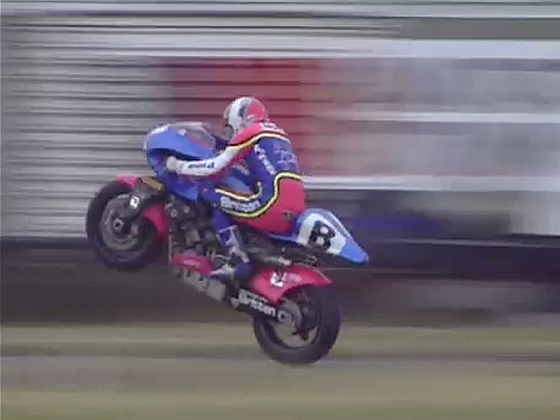
Part one of five from this full length documentary.
Part two of five from this full length documentary.
Part three of five from this full length documentary.
Part four of five from this full length documentary.
Part five of five from this full length documentary.
Credits from this full length documentary.
Britten - Backyard Visionary
Television (Full Length) – 1994
A perspective

Guggenheim Museum curator Ultan Guilfoyle once described inventor John Britten as "the New Zealander who stood the world of racing-motorcycle design on its head". In a poll compiled by the world's leading motorcycle writers to rank the Motorcyclist of the Millennium, he was placed equal with the four founders of Harley-Davidson.
A decade earlier Britten was a Kiwi cliche, tinkering away in his backyard shed, convinced that he could redesign his Ducati racing bike to make it go faster. Triumph at Daytona and world speed records on a homemade superbike were just dreams.
Christchurch filmmaker Harry Ruffell had noticed what Britten was trying to do, and thought there might be a film in it. Britten called Ruffell and told him he was about to start work on what would probably be his last bike. Despite lack of funding, Ruffell took a punt and began filming in 1990.
As the pile of film got higher, Ruffell realised that the enormity of the task of turning the footage into a coherent documentary was beyond his experience. He approached producer Ian Taylor and director Allan Baddock. They immediately saw potential in the story, but Baddock says getting broadcasters to recognise how extraordinary the story was took some doing.
"Ian Taylor and I spent a couple of years pitching and chasing funding. We got repeatedly tossed off with inspired insights such as: ‘So it's a motorbike film ... nobody watches motorbike films', and ‘yeah ... might make 10 minutes for one of the sports programmes'. Our line was that it wasn't about bikes — it was about Kiwis."
The tide turned when TV3's Geoff Steven picked up the project for the channel's new local documentary slot, Inside New Zealand.
Baddock continues: "I went to Christchurch and spent a couple of weeks living with John and the Ruffells and shooting the interviews with Kirsteen and John's long-suffering support crew, reconstructions and linking footage, with Harry as cameraman. I then came back to Dunedin and worked with Marilyn McArthur to edit what we could from the footage."
With no firm idea of what the end result would be, Harry had shot nearly 100 hours of observational footage.
Baddock: "It [the footage] was two mates in a garage. But it gave Marilyn some real headaches. In truth, it became a labour of love. Marilyn and I spent god knows how many weeks in the edit suite. If we'd had to do it within a normal production schedule, the film wouldn't have seen an audience — but it was too good a story to let go."
The end result is an engaging celebration of Kiwi ingenuity, with the relationship between John and his long-suffering yet fiercely loyal wife Kirsteen being particularly well drawn.
The only real downside of the film's low budget was that the producers were unable to properly document Britten's dramatic breakthrough at Daytona in 1992. This is shown via photographs and narration, which dilutes the impact of the climax somewhat, although it is in keeping with the shoestring, Kiwi-can-do spirit he epitomised.
Despite the fact that John Britten was largely unknown at the time it screened, the documentary gained good ratings in its slot. By the time he died of cancer a year later (1995), John Britten had become a household name.
TV3 screened Backyard Visionary again as a tribute to a new Kiwi hero. His bike is now on permanent exhibit at NZ's national museum, Te Papa Tongarewa. In 1995 an award was named in his honour by the New Zealand Design Institute, to recognise excellence in design.
- The work of filmmaker Costa Botes includes a run of documentaries, among them Angie, Struggle No More and The Last Dogs of Winter.

If you liked this, you might also like...
Christchurch
As a showcase history of Christchurch onscreen this...
Kiwi Ingenuity
Embodied in heroes from Pearse to PJ, Kiwi ingenuity is a...
Speed
From fast-running humans and animals to motorhead mayhem,...
NZ On Screen Turns 10
From Britten to Bugger, this collection celebrates 10...
The World's Fastest Indian
A film about fellow cycle renegade Burt Munro
Love, Speed and Loss
Another Kiwi motorcycle design legend
Trio at the Top
Documentary about NZ motor-racing legends McLaren, Amon...
Let's Get Inventin' - Very Lazy Boy Chair
John Britten’s son Sam does some inventing of his own
Monaco Monza Macao Wellington
Documentary following the BMW team in the 1989 Wellington...
Circuits of Gold
Another champion with a need for speed
Inventions from the Shed
More Kiwi inventiveness
If You're in it, You're in it to the Limit - Bikies
More motorcycle action
Journeys Across Latitude 45 South (part three) - Old Gold New Gold
Also directed by Ian Taylor
Contact - The Turn of the Wheel
NZ motor racing driver in the US
Jack Brown Genius
A story in which the spirit of a thousand year old Monk...
Weekly Review No. 347
1948 NZ Motorcycle Grand Prix features in this newsreel
Smash Palace
Flm about a NZ racing car driver
Extraordinary Kiwis - Scott Dixon
Documentary on Indy Car champ Scott Dixon
Kaikohe Demolition
Demolition derby, Kiwi-style
Weekly Review No. 427
1949 Motorcycle Grand Prix
Jet Boats in New Zealand
Another Kiwi inventor

NZ On Screen - See Us Go
A scene from Britten features in this NZ On Screen promo
Le Ride
Another famous Kiwi on a bike
Newsnight - Rastus the Cat
More motorbikes
AA Torque Show - Series Two, Episode Seven
Rider Aaron Slight is a presenter
McLaren
Another Kiwi motor racing legend
Wayne
Another documentary about motorbike racing
Geoff Perry
Another documentary about Kiwis and motorbikes
Offerings to the God of Speed
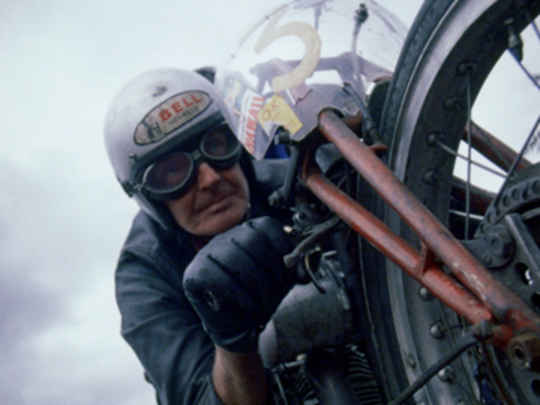
Documentary on motorcycle record holder Burt Munro
Postscript (The Best of Inside New Zealand)
The doco is revisited 43 minutes into this best of special
Blokes 'n' Sheds
Documentary on more out-there kiwi inventors