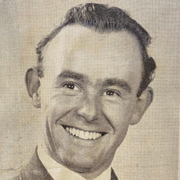
Alan Wilks (aka Alan Jervis)
Alan Wilks acted on radio, television and on Wellington's theatre stages. Born on 19 February 1930 as Alan Jervis Wilks, he adopted the name Jervis for his acting work, to keep the two lives separate. In a 1970 Listener interview, he spoke of how "this Wilks-Jervis business is really a bit of a curse . . . Sometimes people who know me as an actor wonder why I'm living with Mrs Wilks".
The versatile actor used his skills to freelance across three decades, including appearances in some of New Zealand's earliest TV dramas. As he told The Listener, "One day, I might have Shakespeare in the morning, dash off to a studio to do a batch of commercials over lunchtime, then on to Broadcasts to Schools in the afternoon, and in the evening I may go to one of the film producing houses to do a commentary. Being able to adapt oneself is considered professional; stock-in-trade. It's almost like being several different people."
New Zealand's first locally-written television play debuted in May 1963. Reviews of All Earth to Love (and its cast) crossed the gamut from upbeat ("a little gem") to appalled ("shocking", as The Listener put it). Set in a New Zealand Railways café, the romance was captured largely in a crammed Wellington TV studio.
Wilks starred as a young Englishman who meets another traveller (Pamela James). Despite some harsh critiques of the plot — with its echoes of classic David Lean romance Brief Encounter — both actors were applauded for their work. Truth newspaper argued that Wilks and James "interpreted their roles with clarity and insight, though the honours undoubtedly went to Mr. Jervis — he was restrained and convincing." The Auckland Star called him "outstanding".
In the same period, Wilks introduced this interview with Prime Minister Keith Holyoake, and contributed to 1962 comedy record Kiwi Soup. Later he had a supporting role in another early Kiwi teleplay: Julian Dickon's Green Gin Sunset (1969), the tale of a merchant seaman trying to decide whether to settle down.
Wilks continued his work in radio, including Big Bertha (1964). But overexposure was a danger. Although he won good reviews, it was around this time that a spirited exchange of letters in The Listener argued that there was a 'clique' of Wellington actors; a "monotony of voices" that took all the voice/acting roles.
In the late 60s, Wilks narrated children's tale The Island (1965). His voiceover work had begun as early as the late 1950s, and included multiple projects for government filmmakers the National Film Unit — including this award-winning documentary on potter Barry Brickell, and C'mon to New Zealand, which advertised Aotearoa as a fun and 'happening' place to Australian tourists. The film was not Wilks' first rodeo, in terms of promotional work. In 1962, he had worked on a kerosene advert which the Hollywood Advertising Club named the World's Best in its category.
In August 1969, Wilks was elected president of the Wellington branch of Actors' Equity. The new branch joined existing ones in Auckland and Christchurch. Wilks pushed for the establishment of a new channel to showcase more local work, and for all channels to devote more resources to local productions, to help establish a national identity.
He went on to hit screens with a bang in controversial teleplay The Killing of Kane (1971), playing real-life deserter Charles Kane — one of two Pākehā who had joined Tītokowaru during the New Zealand Wars of the 1860s. It marked the first time a local TV production had examined race relations between Māori and Pākehā. Peter Vere-Jones played Kane's more sympathetic colleague. Author Annabel Cooper argues that the teleplay paid "a great deal of attention to cultural perspective: how can Pākehā see these events as Māori saw them? How might Pākehā conduct themselves among Māori?"
Although The Killing of Kane was shot in colour, on location in Hāwera, the nation saw it in black and white — colour broadcasting had not yet hit New Zealand. Reviewer (and director) Paul Maunder wrote that "Jervis gave the best TV performance I have yet seen in a local production". Catherine de la Roche argued that the drama's "outstanding" scenes "were those between Alan Jervis and Peter Vere-Jones as Bent, the deserters isolated in guilty resentment..."
A year after co-starring in The Killing of Kane, Wilks played one of the detectives trailing a mysterious group of body-snatchers in quirky — and award-winning — one-off drama An Awful Silence.
In 1977, Wilks played politician and government official Donald McLean in another tale which turned NZ history into drama; epic miniseries The Governor. Wilks appeared in half of the six episodes, which overturned the 'peacemaker' reputation of 19th century Governor George Grey, The high rating series won Best Drama at the Feltex Awards in 1978, and episode four was awarded Best Script.
Wilks next featured in Skin Deep — one of the earliest features funded by the newly established NZ Film Commission. He played a small-town gym owner who agrees to employ a masseuse from the city in a bid to attract more tourists. The same year, he acted in soap Close to Home, before playing a troubled father in cross-cultural romance Sons for the Return Home.
Wilks hit the big screens again in 1981 as one of the assorted cops in Kiwi classic Goodbye Pork Pie. Soon after, he got to star in another tale of road trip shenanigans, Hang on a Minute Mate — this time playing Barry Crump's rowdy anti-hero Sam Cash. The role offered the chance to utter memorable lines like "I'd rather go to bed with a wet dog and cook me own tucker". Goodbye Pork Pie star Kelly Johnson co-starred. The story followed two vagabonds getting up to mischief, after a pit stop at the Hokonui pub.
Wilks guested in multiple TV series, including pioneering bicultural drama Pukemanu (1971), cop show Mortimer's Patch (1981) and Jon Gadsby's rural sitcom Rabbiter's Rest (1983).
Drama series Seekers launched in 1986. Wilks played Jim Alterman, and was reunited with Pamela James, who had worked with him on his earliest TV production, All Earth to Love. One of his final screen credits was narrating 1989's Under the Ice — an award-winning Natural History New Zealand documentary which reveals the life forms under the Antarctic.
Outside of his acting work, Alan Wilks was a Civil Defence warden, a farmer, a wetland conservationist and an avid gardener. He died on 28 October 2017 at his home in Greytown. He was 87.
Profile written by Imogen Porter; published on 24 October 2025
Sources include
John Berry, 'NZBC's First TV. Play A Fine Job' (Review of All Earth to Love) - The Auckland Star, May 1963
Robert J Bromby, Review of All Earth to Love - The Listener, May 1963
Liz Brook, 'Obituary for Alan Jervis Wilks', Ducks Unlimited New Zealand website. Loaded 6 March 2018. Accessed 4 July 2022
Annabel Cooper, Filming the Colonial Past - The New Zealand Wars on Screen (Otago University Press, 2018) Page 101
Trisha Dunleavy, Ourselves in Primetime (Auckland University Press, 2005)
Catherine de la Roche, 'Kane' Had Fine Moments' (Review of The Killing of Kane) The Dominion Post, 2 June 1971
Paul Maunder, 'The Killing of Kane' (Review) - Association of Community Theatres magazine, 1971
Unknown writer, 'The Killing of Kane a pronounced success' (Review of The Killing of Kane) - The Christchurch Press, 27 May 1971
'Rabbit ear' , 'NZ's TV Drama Away To A Good Start' (Review of All Earth to Love) - NZ Truth, May 1963
Unknown writer, 'Several Different People' (interview) - The Listener, 4 May 1970
Ngā Taonga Sound & Vision catalogue. Accessed October 2025
Playmarket website. Accessed October 2025