KitRollings
- Sound
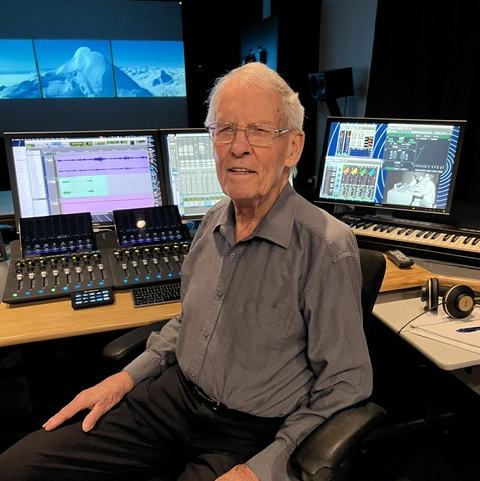
During his long tenure at the National Film Unit, Kit Rollings was sound recordist and sound designer for several of their most enduring projects, including This Is New Zealand and The Governor. A founder of Memory Line Productions, Rollings also won numerous awards during his freelance career, working with Lee Tamahori, Gaylene Preston, Alison MacLean and Peter Jackson.
Awards
1997 International Film and Video Festival (United States)
Award for Creative Excellence in Audio: for North Island Main Trunk
1994 New Zealand Film and Television Awards
Best Soundtrack (shared with Ray Beentjes, Michael Hedges and Graham Morris): for Once Were Warriors
Biography
In 2022, This is New Zealand was inscribed on the UNESCO Memory of the World register, but in 1969 Kit Rollings never imagined it screening outside of Expo '70 in Osaka. After "puzzling over" the stereo sound recording by synchronising two mono Nagra tape recorders, assisting with music selection, and mixing the multiple triple-tracks and mono sound, Rollings was sure the week set aside for screenings to politicians, friends and family would be the only chance to watch it on these shores. "We were astonished that people came out of the screening in tears," he recalls. After becoming "the most popular film" at Expo '70, projection boxes were built or adapted in several cinemas to screen it in Aotearoa, where it became a national classic.
This is New Zealand came four years into Rollings' tenure at the National Film Unit, a role he had acquired through careful subterfuge. "I realised that I'd never be able to get a job that I wanted if I owned up to being blind ... but I managed to bluff my way through." With no sight in one eye and "stuff all" in the other, Rollings acknowledged that he couldn't drive but carefully side-stepped any questions pertaining to sight. Only after nearly sliding down a mountain during a night shoot for Compass - First Five Years of Television, did Rollings ever tell a colleague.
"There was no training, as such, at the Film Unit," with everyone learning the equipment on the job — an approach made more complicated by Rollings' inability to read footage counters and, later, timecodes from afar. Yet he quickly proved beyond competent, developing new systems and solving problems long thought unsolvable. From splicing together overlaps for seamless transitions to using a tape-head demagnetiser to create fades and avoid jarring audio changes, Rollings' innovative techniques became the standard. "I don't like hubris, but I do the job better than a lot of others."
His first solo job as editor and tracklayer was Only One Standard, about the freezing works at Ngauranga Gorge, which remains the piece Rollings feels most proud of. "I had the sound perfect for every process," he says — a rarity in those days, when documentaries would instead use generic 'noise', stock music and commentary. Following this success, Rollings worked on This Auckland, his first job with long-time friend and collaborator Hugh Macdonald. This comprehensive and unconventional portrait of Auckland won the Lion of St Mark Plaque at the 1967 Venice Film Festival and other commendations in Taiwan, Edinburgh and Czechoslovakia.
Rollings contributed to an NFU submission for the 1974 Commonwealth Games film in Christchurch, when New Zealand was tasked with producing the official film for the games. The submission shot empty venues, while Rollings devised an imagined soundscape to bring each space to life. When the NFU won the job, Rollings took the role of Head of Sound for the film. It proved a mammoth undertaking, coordinating thirteen crews alongside Kel Fowler’s camera department and recording live sound feeds from the pool, track, and field events on stereo Nagra machines. As Rollings recalls, “Kel and I had to wait until the last crew returned at night … We never made it back to our accommodation until well after midnight.”
Rollings and Hugh Macdonald worked together again for the seminal 1977 television drama series The Governor. As shooting went over schedule — "the project itself wasn't difficult, but it was the hours we worked" — the intended multi-month break between on-location and post-production disappeared and Rollings went straight from sound recording to sound editing, often working seven days a week. "At the end of it, I just collapsed. It was on the sound mix of the last episode. During the mix, the room started spinning. I just lay down on the floor and said, 'Take me home!'... I don't think I ever fully recovered from it."
Across his long career, the methods of on-location sound recording changed drastically. Again directed by Macdonald, Rollings and Tony Johnson recorded and edited Logger Rhythms, the first New Zealand film to use Dolby Stereo. As local laboratories couldn't produce prints or sound negatives with this new technology, the sound was processed in Australia and Rollings sent a reject print to Dolby Laboratories in the UK for evaluation. Despite his being severely told off for sending copies overseas without approval, Dolby liked Logger Rhythms so much that they used it for 10 years as a technological showcase in their lab theatre.
By the early 80s, the National Film Unit was on the chopping block. "Muldoon hated The Governor," Rollings asserts. "He hated television and he was out to get television one way or another." Although financial returns were limited, the intended purpose of the NFU had been successful: promoting New Zealand's interests overseas. When Hugh Macdonald left, Kit Rollings followed him — resigning as sound director and telling Hugh, "You kept me employed all those years," before they both went freelance. Alongside another ex-NFU director, David Sims, Macdonald and Rollings set up Memory Line Productions in 1990, producing seven documentaries about New Zealand railways that sold thousands of copies on home media.
Rollings also had a long-running collaboration with Dame Gaylene Preston, first working together on Keri Hulme documentary Kai Pūrākau, then feature film Ruby and Rata and television documentaries Hone Tuwhare: No Other Lips, Getting to Our Place and Titless Wonders — the latter being his final sound editing credit. Preston's 1993 epic miniseries Bread and Roses also marked the final time Rollings ever used magnetic film for sound editing, with every following project being mixed digitally.
Rollings' stories of sound design are fascinating: from fixing mistakes such as the crash of a toppled music stand during an aria by Kiri Te Kanawa, to recording his own knees creaking as he crouched down to represent a tuatara eating a wētā for the award-winning 1981 NFU documentary Primeval Survivors. He remembers a distressing day during the mix of Once Were Warriors, with two women undertaking the foley work for the scene of domestic violence — "I could never run that scene without an awful feeling in my stomach." Although Rollings had bought a library of Hollywood punch sound effects, director Lee Tamahori had said, "I want to hear teeth crunching," to ensure the brutality was properly felt.
Of the film industry, Rollings says, "You never make any money, but you make a lot of good friends and have a lot of fun." With other significant films under his belt, like Oscar-nominated animated short The Frog, the Dog and the Devil, Peter Jackson's cult horror-comedy Bad Taste, and notable 90s features Desperate Remedies, Crush and Absent Without Leave, the mark his sound made on our national cinema is indelible. Rollings now lives with his wife in a Wellington retirement village and organises the in-house cinema there. He remains close to his childhood haunt: the locality of Taitville, named after his great-grandfather and teeming with fond memories of exploring nature, building trolley-trains with the other boys and listening to a young Geoff Murphy practising his trumpet every Sunday morning.
Across his life, Kit Rollings has also been creating an expansive sound library, largely from material recorded on his own. "The Nagra was the first thing that went into the car," and with it he has captured music, birdsong, humanity and industry. For Rails in the Wilderness, Rollings realised he had never heard a steam sawmill before and couldn’t accurately recreate the sound. After a search all around the country, he found the only operating steam sawmill left in New Zealand and spent three days recording every aspect of it. Sound needs to be preserved, archived and celebrated just as readily as image, and Kit Rollings' career stands as testament to this.
Profile written by Danny Bultitude, published 20 May 2026
Sources include
Kit Rollings
Hugh Macdonald profile on NZ On Screen
Memory Line Productions website (via Wayback Machine)